+381 63 371 419


Sizing15 min read
Heat pump sizing guide for Serbian homes: 6 kW to 20 kW

TL;DR
The short answer
Most homes in Serbia need a heat pump between 6 kW and 20 kW, depending on floor area, insulation, heating system, climate and hot water demand. Typical ranges are 6 kW up to about 80 m², 9 kW for 100 to 130 m², 12 kW for 140 to 180 m², 15 kW for 180 to 230 m² and a three-phase 20 kW for very large homes. This heat pump sizing guide explains the method, and CENTRO-GAS confirms the EXINDA unit in a sizing consultation.
This heat pump sizing guide shows how floor area, insulation, climate and the heating system set the capacity for a Serbian home. EXINDA units run from 6 kW to 20 kW, with a 9 kW heat pump covering homes of 100 to 130 m². CENTRO-GAS, a Novi Sad company, is the exclusive distributor of EXINDA heat pumps in Serbia.
Floor area alone never sets the size, so checking insulation, emitters, climate and hot water demand before a CENTRO-GAS sizing consultation avoids both a cold house and an oversized unit. The air-to-water heat pump guide covers the wider buying decision.
Heat pump sizing guide: the short answer
Heat pump size comes from four factors: floor area, insulation, climate and the heating system. Typical Serbian homes land between 6 kW and 20 kW. Heat pumps provide roughly 3 to 4 times more heat energy than the electricity they consume, and the IEA puts the typical household ratio of heat out to electricity in at around four.
Four factors that set the size
- Area and floors: the heated rooms on every floor count, and unheated space does not.
- Insulation: walls, roof, floor and windows decide how fast the house loses heat.
- Climate: the length and depth of the cold season set the load the unit must cover.
- Heating system and hot water: the emitters in each room set the water temperature, and household hot water use adds to the load.
Your situation and the likely unit
| Your situation | Likely unit |
|---|---|
| Small home or apartment, up to about 80 m² | 6 kW |
| Mid-sized home, 100 to 130 m² | 9 kW |
| Larger home, 140 to 180 m² | 12 kW |
| Large home, 180 to 230 m² | 15 kW |
| Very large home, light commercial use or small multi-family building | 20 kW three-phase |
These are typical ranges. You can estimate the capacity for your home in the CENTRO-GAS calculator, and a CENTRO-GAS sizing consultation confirms or adjusts the unit for your house. Homes near a band edge, or with high hot water demand, can fall one unit either way.
Why floor area alone is not enough
Floor area is the starting point and never the whole answer. Two homes of 120 m² can need different units if one is well insulated with underfloor heating and the other loses heat through old windows and relies on older radiators. A reliable size comes from checking all four factors, not just the area.
Five-step method to size a heat pump
This heat pump sizing guide uses five steps to take a homeowner from a floor plan to a short list of units. Each step ends with one outcome to write down. This method narrows the size and does not replace a survey.
1. Measure heated area and floors
Measure only the rooms you heat, floor by floor, and note any unusually high ceilings. Unheated attics, garages and cellars stay out of the total.
Outcome: a heated area in square metres and a floor count.
2. Judge the insulation
Check the walls, roof, floor and windows. Rate the house as well insulated, partly insulated or poorly insulated.
Outcome: an insulation rating for the whole house.
3. Identify the emitter system
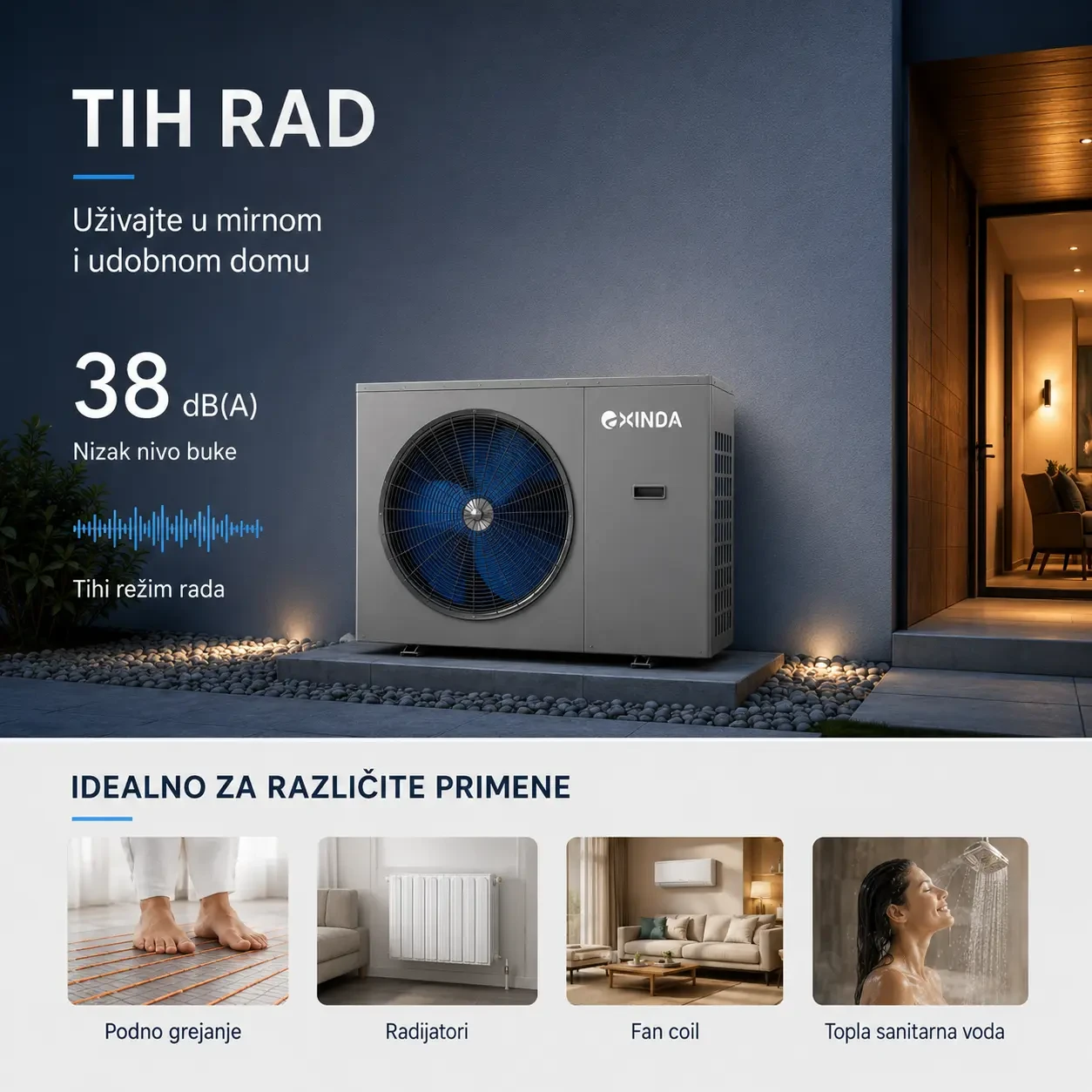
List the emitters in each room: underfloor heating, fan coils or radiators. They set the water temperature the heat pump must reach, and that temperature affects the size. Every residential EXINDA model uses a monoblock heat pump design, built as one unit, and works with all three emitter types.
Outcome: an emitter type for each room.
4. Note climate and hot water needs
The length and depth of the cold season set the load the heat pump must cover over the year. The RHMZ bulletin from Serbia's hydrometeorological service records a lowest air temperature of minus 17.8 °C at Požega in winter 2025/2026, in a season it still rated warm overall. That is one winter, not a norm.
Outcome: a note on how cold your winters get and a note on household hot water use.
5. Get a consultation to confirm
Take the estimate from the CENTRO-GAS calculator to a CENTRO-GAS sizing consultation before installation, so the unit is checked against the real house. Expect questions about the house rather than a number taken from floor area alone. There is no pressure to decide at that stage.
Outcome: a confirmed unit.
Heat pump size by unit: 6 kW to 20 kW
The EXINDA range of residential heat pumps has five units, rated 6, 9, 12, 15 and 20 kW. Each suits a typical home size, and every unit uses R290 (propane) refrigerant and a monoblock design.
Sizing table
| Unit | Typical home size | Typical situation | Energy class (35 °C flow) | Noise at 5 m | Product |
|---|---|---|---|---|---|
| 6 kW | Up to about 80 m² | Small home or apartment | A+++ | 33 dB(A) | Exinda 6 kW R290 |
| 9 kW | 100 to 130 m² | Mid-sized home | A+++ | 35 dB(A) | Exinda 9 kW full DC inverter |
| 12 kW | 140 to 180 m² | Larger home | A+++ | 36 dB(A) | Exinda 12 kW R290 |
| 15 kW | 180 to 230 m² | Large home or small commercial space | A+++ | 38 dB(A) | Exinda 15 kW DC inverter |
| 20 kW three-phase | Very large homes | Light commercial use or small multi-family building | A+++ | 41 dB(A) | Exinda 20 kW 3-phase |
These are typical ranges only, and a consultation confirms the unit for your house. Energy class and noise figures follow the CENTRO-GAS residential heat pump category listing.
What moves a home up or down one size
Poor insulation, older radiators, cold exposure and high hot water demand push a home up one unit. Good insulation, underfloor heating and mild exposure let it move down one. Homes that fall between two bands, such as 90 m² or 135 m², need a closer look.
Refrigerant and unit type
Exinda residential units use R290 refrigerant, which is propane. GWP stands for global warming potential, and Autarc gives R290 a GWP of 3. Alfa Laval also lists propane at a GWP of 3.
Autarc notes that R290 is highly flammable and carries safety class A3. The CENTRO-GAS article R290 heat pump explained covers the refrigerant in more depth.
How insulation changes the size
Insulation often shifts the unit a home needs within the 6, 9, 12, 15 and 20 kW range. Two homes with the same floor area can need different units.
What to check in a home
Heat leaves a building through its fabric, meaning doors, windows and floors, and through ventilation loss from draughts, according to Baxi. So check the walls, roof, floor and windows, and look for draughts too. The same source adds that the makeup of the fabric can change the calculated heat loss significantly.
Two contrasting homes
Take two homes of similar area. One has insulated walls, an insulated roof and modern windows. The other has uninsulated walls and old windows.
The poorly insulated home may need a larger unit, for example 12 kW instead of 9 kW as an illustration only. The Exinda 12 kW guide explains that model.
Insulate first or buy more capacity?
Better insulation can let a smaller unit do the job, though it takes money and is not possible in every building. More capacity avoids the building work but costs more to buy and to run.
Poorly insulated homes need remediation or more capacity, and the better route depends on the building and the budget. A consultation weighs both routes for your house, including what each would involve.
How the heating system changes the size
Emitters set the flow temperature, which is the temperature of the water the heat pump sends to the heating system. Flow temperature affects both the efficiency and the size of the unit. In general, lower flow temperatures tend to favour the smaller unit in a band.
Best-fit homes
The best-fit homes pair a heat pump with decent insulation and an efficient emitter system, such as underfloor heating, fan coils or good radiators. Homes that lack either can still use a heat pump, but they may need remediation, emitter upgrades or a larger unit. Saying so openly avoids surprises after installation.
Underfloor heating
Underfloor heating works with low water temperatures, such as the 35/30 °C flow and return regime that BUILD UP, the European Commission's building energy portal, cites for heat pumps. A heat pump runs efficiently at these temperatures, and in general a home with underfloor heating tends toward the smaller end of its size band, which a consultation confirms.
Fan coils
Fan coils sit between underfloor heating and radiators. Eurovent, the European HVAC industry association, notes that fan coils are designed to work at low water temperatures. In general, a home with fan coils tends to sit in the middle of its band, which a consultation confirms.
Radiators, including older ones
Heat pumps generally supply heating water at around 40 to 45 °C, according to the Energy Saving Trust, so radiators may need to be larger than with a boiler. Older heating systems were often designed for much hotter water, up to a 90/70 °C regime, as BUILD UP notes. A heat pump still works with older radiators, though some need adjustment.
If they need hotter water, the heat pump works harder and loses efficiency. CIBSE Journal explains that the smaller the temperature lift, meaning the gap between the outdoor air and the heating water, the higher the efficiency. Such a home may need the next unit up or new emitters, and a consultation checks each radiator.
Can a heat pump be too big or too small?
Yes, in both directions. An undersized unit struggles in cold spells, and an oversized unit costs more and cycles poorly. Sizing for the coldest hour of the year would oversize the unit, so an electric heater in the buffer (storage) tank covers those hours instead.
Too small: cold spells
An undersized heat pump struggles to meet the demands placed on it, and Baxi says capacity must be achievable at design conditions. The risk appears in cold spells, when demand peaks.
That is the cold house many buyers fear, and even the winter of 2025/2026, which the RHMZ bulletin rated warm, recorded a low of minus 17.8 °C. Right-sizing is the protection against it.
Too big: cost and poor cycling
An oversized unit costs more to buy and more to run, according to NY Clean Heat. It also switches on and off repeatedly, which brings inefficient operation and extra wear on mechanical parts. The system adds or removes more heat than the home needs, which is what drives the repeated cycling.
The coldest hours and EXINDA testing
A heat pump is not sized for the coldest day of the year, because that would make it three to four times larger than needed for most of the season. Instead, the CENTRO-GAS calculator picks the smallest pump that covers the season, and the roughly forty coldest hours a year are topped up by an electric heater in the buffer (storage) tank. That heater accounts for less than 2% of annual electricity use. Where heating cannot fail, a hybrid heat pump pairs an air source heat pump with a traditional boiler, and Hive says the boiler steps in as backup when it gets very cold.
What to bring to a sizing consultation
A sizing consultation helps you avoid being oversold or undersold, because the unit is matched to your house and not to a floor area. Bring at least these inputs: heated area, floors, insulation, emitters, hot water needs and location, plus anything you know about the existing boiler.
There is no pressure to decide at the consultation. The local CENTRO-GAS technical team that gives the advice also handles installation, commissioning and servicing.
Before you ask for a sizing consultation
- Heated area for each floor
- Number of floors and ceiling heights
- Wall, roof and floor insulation
- Window type
- Emitter type in each room
- Current boiler or fuel and its age
- Hot water needs of the household
- House location
- Electrical supply, single-phase or three-phase
- Outdoor unit position and pipe route
Why each input matters
Area, floors and insulation set the heat demand, and the emitters set the flow temperature the unit must reach. The electrical supply decides whether the three-phase 20 kW model is possible.
Window type and wall, roof and floor insulation show how quickly the house loses heat. The current boiler or fuel shows what the house uses today, and the outdoor unit position shows where the unit can go, so each answer shapes the final choice.
Frequently asked questions
01What size heat pump do I need for my house?
The size depends on four factors: floor area, insulation, climate and the heating system, with high hot water demand pushing a home up one unit. Typical EXINDA units run from 6 kW for homes up to about 80 m² to a three-phase 20 kW for very large homes, light commercial use and small multi-family buildings. The CENTRO-GAS calculator gives a first estimate, and a CENTRO-GAS sizing consultation confirms the unit for your house before installation.
02How many kW per square metre does a heat pump need?
There is no reliable single figure, because insulation, climate and the heating system all change the answer. Two homes with the same area can need different units, so a kW-per-square-metre rule would oversize one home and undersize another. The unit ranges in this guide are typical bands only, and a consultation uses the actual house to confirm the size.
03Does insulation change the heat pump size I need?
Yes, because a poorly insulated home loses heat faster and may need a larger unit, for example 12 kW instead of 9 kW as an illustration only. A well insulated home of the same area can stay with the smaller unit, and improving insulation first can reduce the capacity needed, though it adds building work. A sizing consultation weighs both routes for your house.
04Can a heat pump be too big for a house?
Yes, an oversized heat pump costs more to buy and to run, and it switches on and off repeatedly, which wastes energy and adds wear. An undersized unit has the opposite problem and struggles in cold spells. The aim is a unit matched to the house and the season, with the coldest hours left to the electric heater in the buffer tank.
05What is the difference between 9 kW, 12 kW and 15 kW heat pumps?
They suit different home sizes. A 9 kW unit typically suits homes of 100 to 130 m², a 12 kW unit homes of 140 to 180 m², and a 15 kW unit homes of 180 to 230 m², which can include small commercial spaces. Poor insulation or older radiators can move a home up one unit, while good insulation and underfloor heating can move it down.
Key terminology
- SCOP
- SCOP stands for seasonal coefficient of performance. It shows a heat pump's aggregated annual performance, calculated under the EN 14825 standard with European climate data and part-load conditions, as Designing Buildings explains.
- COP
- COP stands for coefficient of performance, the ratio of heat output to electricity input. The IEA reports a COP of around four for a typical household heat pump.
- GWP
- GWP stands for global warming potential. Autarc gives R290 a GWP of 3.
- R290
- R290 is propane used as a refrigerant. All residential EXINDA units sold by CENTRO-GAS use R290. According to Autarc, it is highly flammable and carries safety class A3.
- Monoblock
- All residential EXINDA units use the monoblock design, including the three-phase 20 kW model. The CENTRO-GAS article on monoblock heat pumps explains the concept.
- Emitter
- An emitter is the part of the heating system that releases heat into a room, such as underfloor heating, fan coils or radiators. The emitter type sets the flow temperature the heat pump must reach. That is why it affects the size.
- Hybrid setup
- A hybrid setup combines an air source heat pump with a traditional boiler. The boiler steps in as backup in very cold weather or when extra-hot water is needed, according to Hive.
Gather the ten checklist inputs and contact CENTRO-GAS in Novi Sad for a sizing consultation, by email at centro-gas@centro-gas.com or by phone on +381 63 371 419. You can also view the residential heat pump category or try the heat pump calculator.