+381 63 371 419


Choosing a heat pump18 min read
Best heat pump for a 100 to 130 m² family house: 7 criteria
TL;DR
The short answer
The best heat pump for a 100 m² house, or any family house up to 130 m², is the one sized at your city's design temperature, usually 9 kW, and 12 kW when weak insulation, a colder city or hotter radiators demand it. Check output on the design day, the flow temperature your radiators need, inverter running in mild weather, noise placement and family hot water. Then choose a local installer who sizes, installs and services it, such as CENTRO-GAS for EXINDA units in Serbia.
A family house of 100 to 130 m² that moves away from gas, oil or solid fuel needs a heat pump sized for its city's coldest days, its insulation and its radiators. The seven criteria in this article are a checklist for anyone comparing offers for the best heat pump for 100 m2 house sizes up to 130 m². CENTRO-GAS, a Novi Sad heating company, supplies and installs EXINDA air to water heat pump units in Serbia.
For the method behind every size in the range, read the sizing guide for Serbian homes.
Why the same house needs different sizes
The CENTRO-GAS kalkulator uses a design temperature of minus 12 °C for Beograd and minus 18 °C for Subotica. It also applies the rule that a unit rated 12 kW gives about 6 kW at minus 15 °C.
Output falls in the cold, so the same 120 m² house needs a different size in Beograd than in Subotica. The seven criteria let you check any offer against that standard.
The three checks that matter most
Three checks decide most of the outcome for a house in this size band. Each one is a question you can put to any installer.
- Ask for the unit's output at your city's design temperature, not only its rated output.
- Ask which flow temperature your radiators or underfloor heating need on the coldest day.
- Ask who installs, commissions and services the unit locally after payment.
The seven criteria at a glance
The table scores requirements, not brands. Use it to compare offers line by line, starting with the criterion that moves the size most.
| Criterion | Why it matters at 100 to 130 m² | What to ask the installer | What a good answer sounds like |
|---|---|---|---|
| 1. Capacity at design temperature | Output falls in the cold, and design temperatures run from minus 12 °C to minus 20 °C across Serbia | What does the unit give at our city's design temperature? | A figure for your city's design day, taken from a sizing calculation |
| 2. 9 kW or 12 kW | 9 kW covers the typical 100 to 130 m² band, 12 kW the typical 140 to 180 m² band | Which conditions in our house point to 12 kW? | Reasons tied to insulation, city, ceiling height and radiators |
| 3. Flow temperature | Panel radiators often need hotter water than underfloor heating | What flow temperature do our radiators need on the coldest day? | A temperature for your emitters, plus any radiator changes |
| 4. DC inverter compressor | Most heating days are milder than the design day | Does the unit slow down in mild weather? | Yes, with the inverter-controlled parts named on the datasheet |
| 5. Noise and placement | The outdoor unit sits near bedrooms and neighbours | Where will the outdoor unit stand, and on what base? | A spot away from windows and the boundary, on a solid base |
| 6. Hot water | A family uses more hot water than a couple | How big a tank, and how is priority set? | A tank sized to your household, with priority explained |
| 7. Local installation and service | Someone must commission and service the unit for years | Who services the unit after installation? | A named local team with a maintenance contract |
1. Capacity at your city's design temperature
Judge a heat pump by the heat it gives on your city's coldest design day, not by the figure on the box. Design temperature is the outdoor temperature a heating system is sized for at a given location. The Energy Saving Trust toolkit tells installers to choose a unit that covers 100% of the house's heat demand at that temperature.
Design temperatures across Serbia
The CENTRO-GAS kalkulator uses these winter design temperatures for Serbian locations. A house in Subotica is sized for a day 6 °C colder than the same house in Beograd (minus 18 °C against minus 12 °C).
| City | Winter design temperature |
|---|---|
| Beograd | minus 12 °C |
| Niš | minus 12 °C |
| Novi Sad | minus 15 °C |
| Zrenjanin | minus 15 °C |
| Sombor | minus 16 °C |
| Užice | minus 16 °C |
| Subotica | minus 18 °C |
| Mountain areas | minus 20 °C |
Source: CENTRO-GAS kalkulator.
Why output falls in the cold
An air-to-water heat pump takes its heat from the outdoor air. The installer toolkit notes that peak output figures fall as the outside air gets colder and as flow temperature rises.
The CENTRO-GAS kalkulator applies a simple rule: a unit rated 12 kW gives about 6 kW at minus 15 °C. You can run the kalkulator on the CENTRO-GAS shop with your own city's figure.
A 115 m² house in three cities
Take one illustrative 115 m² house and move it between three cities. It is sized for minus 12 °C in Beograd, minus 15 °C in Novi Sad and minus 18 °C in Subotica, so the output it needs on the design day rises from city to city. Kalkulator results for your own address are estimates, and a sizing consultation confirms them.
What this means for your home: Ask every installer for output at your city's design temperature. A rated figure alone does not show whether the house stays warm on the coldest days.
2. 9 kW or 12 kW for your house
In the CENTRO-GAS range, the 9 kW unit is listed for mid-sized homes of typically 100 to 130 m², and the 12 kW unit for larger homes of typically 140 to 180 m². Those bands are a starting point, not a verdict. The right capacity still depends on insulation, climate and the heating system, which is why CENTRO-GAS provides a sizing consultation.
What pushes a house to 12 kW
Four conditions can move a house in this band up to 12 kW:
- weak insulation, so the house loses heat faster
- a colder city such as Subotica or Sombor
- high ceilings, which add volume to heat
- radiators that need hotter water on the coldest days
If your house sits near 130 m² and meets several of these conditions, the guide for villas and two-family houses covers the next size up.
Why bigger is not a safe default
Heat Geek points to a legacy of oversized heat sources left by the boiler industry. The NYS Clean Heat program explains that an oversized heat pump cycles on and off because it adds more heat than the home needs.
Its guidance is direct: "An oversized heat pump will be more expensive to operate." Size depends on insulation, area, climate and emitters, so the calculation comes first.
What this means for your home: Treat 9 kW as the usual starting point for this band. At 120 m², the 9 kW vs 12 kW heat pump choice follows the calculation.
3. Flow temperature that suits your radiators
Flow temperature is the temperature of the water the heat pump sends to your radiators or underfloor pipes. The lower it can be, the more efficiently the system runs. Heat Geek states that the lower the temperature a system runs at, the higher its efficiency, so ask for the unit's maximum flow temperature on the datasheet and compare it with what your radiators need.
Radiators, underfloor heating or both
Many family houses in this band heat with panel radiators, and some add underfloor heating in part of the house. The Irish energy agency SEAI lists default design flow temperatures of 35 °C for underfloor heating and 55 °C for radiators. Owners of older houses with radiators can read a dedicated guide.
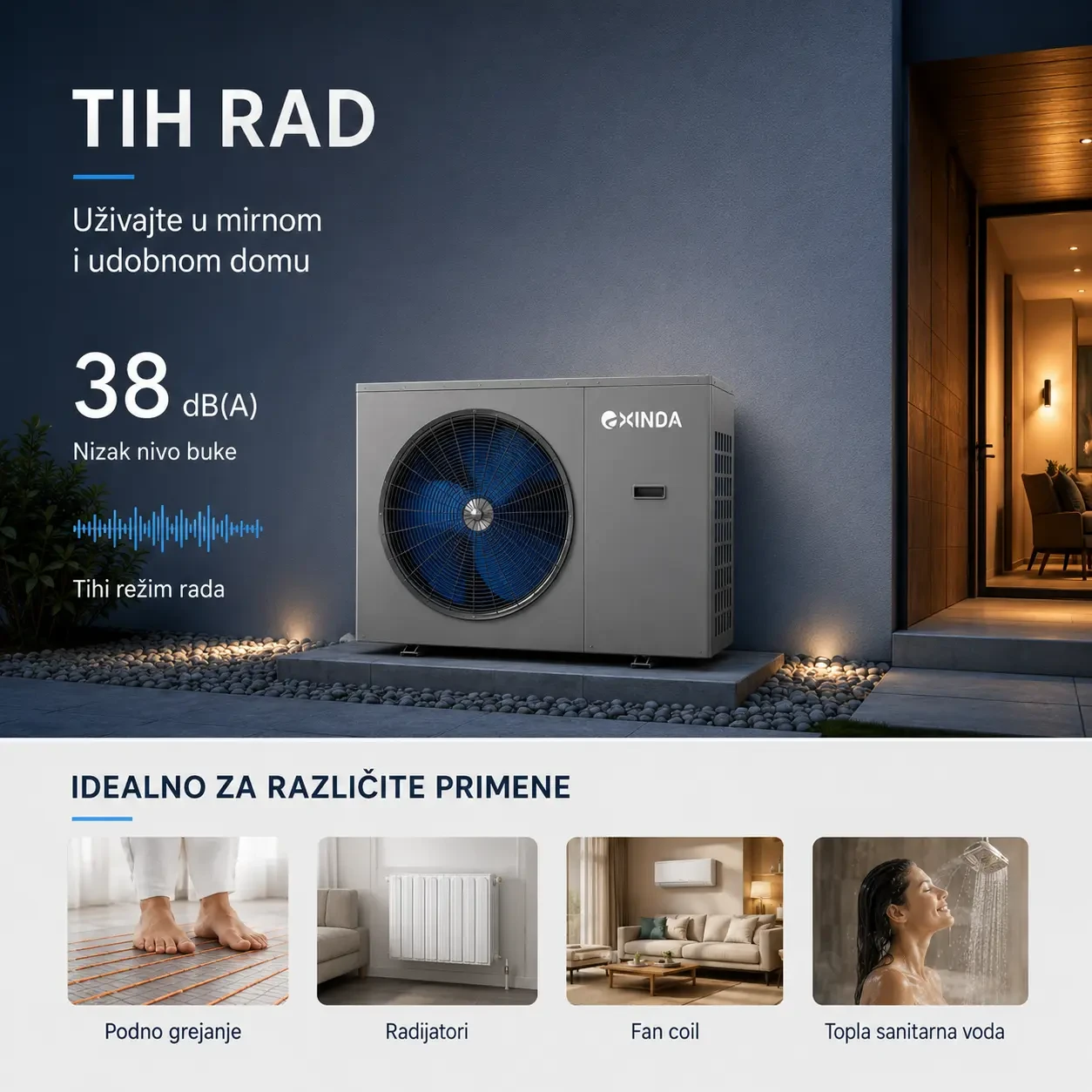
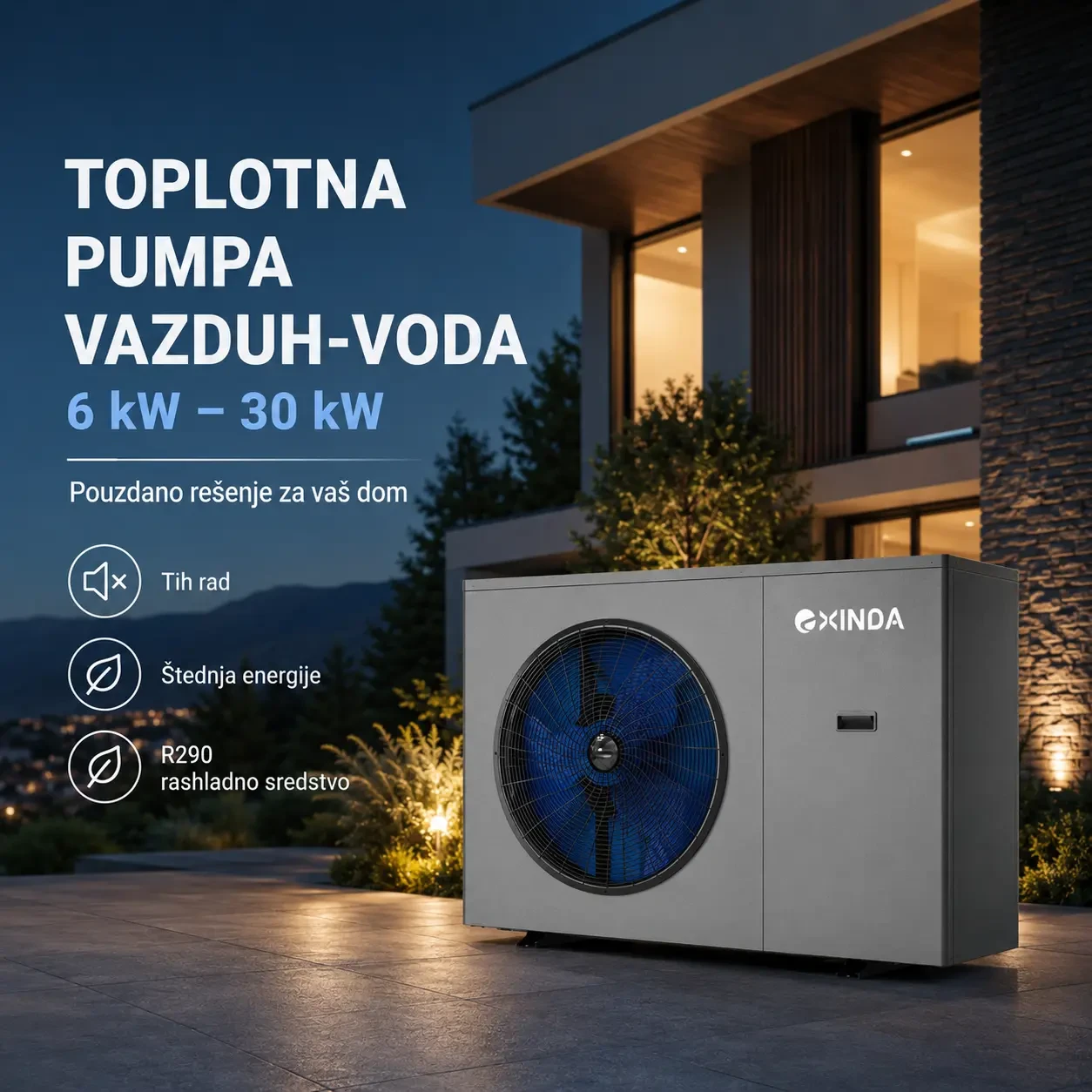
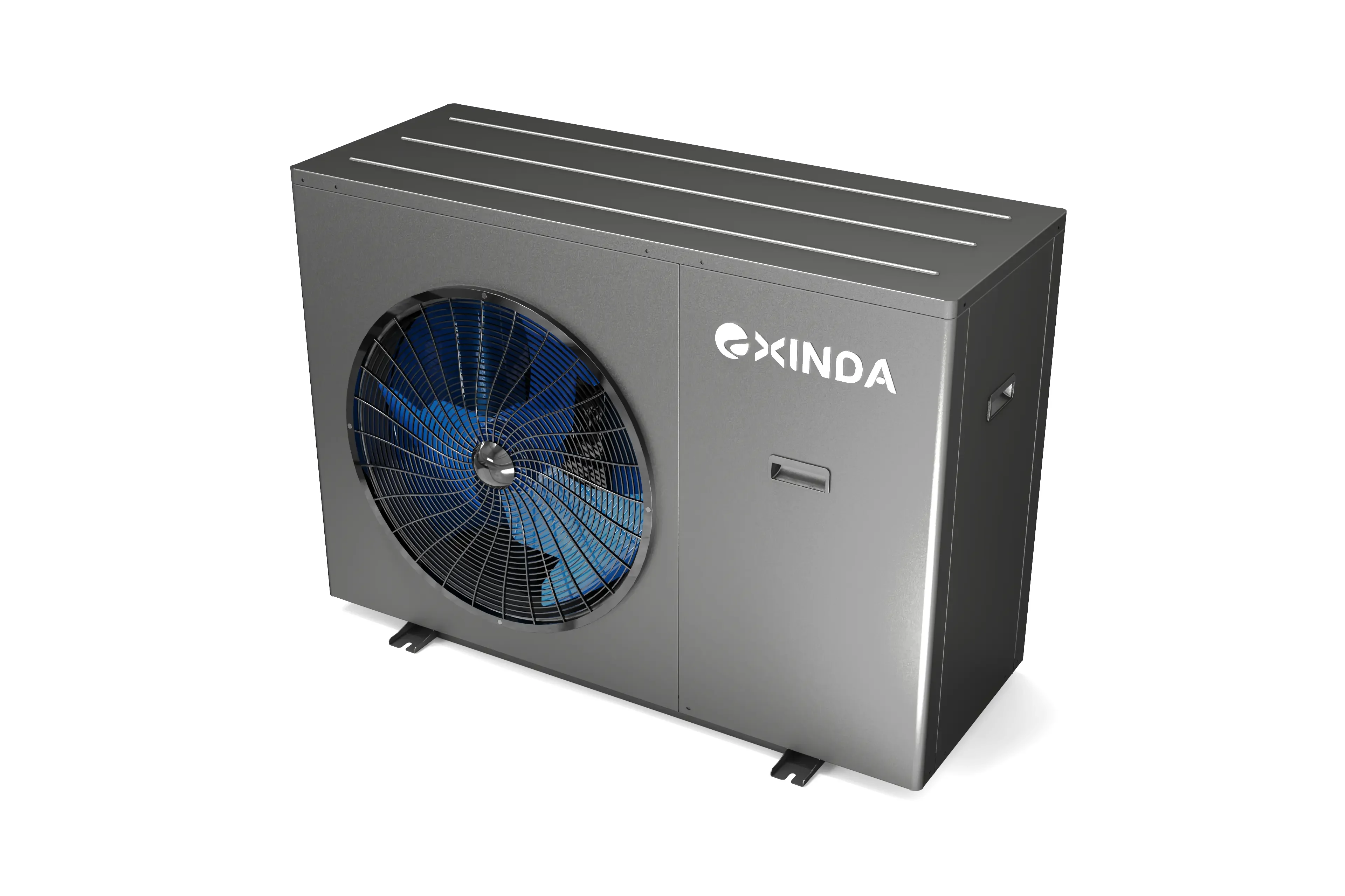
EXINDA builds every residential unit in the CENTRO-GAS range as an R290 monoblock that works with radiators, underfloor heating, fan coils and hot water tanks. Monoblock means the refrigerant circuit stays inside the outdoor unit. R290 is propane used as a refrigerant with a low global warming potential.
What efficiency figures mean
Heat pumps give roughly 3 to 4 times more heat energy than the electricity they consume. SCOP (seasonal coefficient of performance) describes that efficiency across a heating season. Heat Geek explains that a SCOP of 3 means one unit of electricity gives three units of heat.
The trade-off is real: older radiators may need hotter water or an upgrade. Heat Geek calls radiator sizing the most important factor, especially on older retrofits.
What this means for your home: Ask what flow temperature your radiators need on the design day. Then check which radiators need changing before you sign.
4. DC inverter compressor for mild-weather running
A DC inverter heat pump slows down in mild weather instead of switching on and off. An inverter is the electronic control that changes motor speed to match the heat the house needs. That matters because the design temperature describes the coldest planning day, so most heating days are milder.
Compressor, fan and pump
The City of Toronto explains that a single-stage heat pump is either fully on or fully off, while an inverter-driven, variable-capacity unit can closely match its output to the needs of the home. Start-up matters too, and NYS Clean Heat puts it plainly: "Like most machines, heat pumps are least efficient when first starting up."
Every residential unit in the CENTRO-GAS range, from 6 to 20 kW, uses a DC inverter compressor, not just the 9 kW unit. Ask for the datasheet to confirm which other parts, such as the fan and pump, run on inverter control.
Electrical supply
Ask the installer which electrical supply the unit needs and whether your connection suits it. The 6, 9 and 12 kW units run on a 220-240V single-phase supply, while the 15 and 20 kW units need a 380-415V three-phase supply.
What this means for your home: Ask whether the unit slows down in mild weather and which parts run on inverter control. Check the supply type before the installation date.
5. Noise and placement around the house
Where the outdoor unit stands decides how it sounds to your household and your neighbours. A City of Vancouver guide names the fan and the compressor as the two sources of noise, and notes that the outdoor unit needs clear airflow to keep its efficiency high.
Bedroom windows and the boundary
An installation guide from the City of North Vancouver advises placing the unit as far from the property line as possible and away from neighbouring windows. It also warns that hard surfaces can reflect sound towards a neighbour.
The same thinking applies to your own bedroom windows. The guide sums it up: "If you can see it, you can usually hear it."
A solid base and the datasheet
The City of North Vancouver guide recommends mounting the unit on the ground, on a solid base such as a concrete pad. Manufacturers specify a sound power rating, a lab-tested measurement taken at full capacity. Compare that rating across offers instead of relying on a sales description.
What this means for your home: Agree the outdoor unit's position and base before installation day. Ask for the rated sound power on the datasheet of every unit you compare.
6. Hot water for a family
A heat pump can heat a hot water tank alongside space heating. The Energy Saving Trust confirms that it can heat water stored in a cylinder for taps, showers and baths. All residential EXINDA units in the CENTRO-GAS range work with domestic hot water tanks.
Family demand
A family of four uses more hot water than a couple, and demand changes as a household grows. Energy Victoria advises that sizing should account for more than the number of bedrooms, and that demand might rise with children or tenants.
Tell the installer about planned changes in the household before the tank is sized.
Tank size and priority
The installer sizes the tank for your household and sets the priority between space heating and hot water. Ask how the system behaves on a cold morning when showers and radiators both call for heat. The Victorian hot water guide suggests a larger system for high hot water use.
What this means for your home: Tell the installer how many people live in the house and when they use hot water. The tank size and priority settings follow from that.
7. Local installation, service and the brand question
The best brand for your home is the unit that meets these seven criteria for your house, installed and serviced by someone accountable locally. A heat pump is a system, and its results depend on sizing, the emitters and the installation. The brand on the casing is one part of that picture.
Who stands behind the unit
CENTRO-GAS is an established Novi Sad company that manufactures, services and installs industrial burners and heat systems. Its team covers consultation, installation, commissioning, maintenance contracts and after-sales support. That matters if your main worry is a seller who disappears after payment.
What the factory brings
CENTRO-GAS is the exclusive distributor of EXINDA heat pumps in Serbia. According to EXINDA, the factory covers 60,000 m², produces over 1,000 units a day and has installed more than 65,000 units to date, with 100% quality control in production.
EXINDA units operate down to minus 25 °C and are tested in climate chambers to minus 40 °C. For extreme cold snaps, a hybrid setup with a backup boiler remains a legitimate option.
What this means for your home: Ask who commissions the unit, who services it and how to reach them. Choose the offer that answers all three clearly.
The CENTRO-GAS option for this band
Typical option for this band: For a 100 to 130 m² family house, CENTRO-GAS installs the Exinda 9 kW. Capacity is always confirmed in a sizing consultation before an offer is made.
Three family houses in this size band
Three illustrative profiles show which criteria decide the size inside this band. They are examples, not CENTRO-GAS installations, and floor area alone is not a sizing method. Design temperature and heat loss decide, and the kalkulator gives an estimate for each address.
105 m² insulated single-storey house in Beograd
Beograd shares the mildest design temperature in the kalkulator table, minus 12 °C, and good insulation keeps heat loss down. Both factors point towards the 9 kW band. Capacity still follows a calculation for the actual house.
120 m² two-storey house in Novi Sad with radiators
Novi Sad is sized for minus 15 °C, and panel radiators make flow temperature the deciding question. If the radiators need hotter water on the coldest days, the required output rises. A house heated by underfloor pipes can run at a lower flow temperature, as the guide on new builds with underfloor heating explains.
128 m² older house in Subotica
Subotica is sized for minus 18 °C, and an older house often has weaker insulation. A colder city and weak insulation are two of the four conditions that can push a house in this band to 12 kW. A sizing consultation shows whether insulation work or more capacity is the better route.
Getting started
Start by running the CENTRO-GAS kalkulator with your city's design temperature, then confirm the size in a sizing consultation. The residential heat pump range on the CENTRO-GAS shop lists the 9 kW unit for this band and the 12 kW unit for the next band up, both with installation by the CENTRO-GAS team.
Installation packages
Installation packages: CENTRO-GAS plans three tiers, Basic, Standard and Premium. Each tier includes a service contract and is priced as a complete project rather than a unit alone. The tiers let you compare whole projects, including commissioning and service, instead of unit prices. The 12 kW and 15 kW units carry promotional pricing while the first container is in stock; the 9 kW unit is in stock at the standard shop price, and the 6 kW and 20 kW units are available to order, price on request.
Subsidy help
State subsidies for energy-efficient heating can cover a significant share of the cost. CENTRO-GAS helps you check current program requirements and issues the pro forma invoice (predračun) you need to apply. Programs change, and the CENTRO-GAS heat pump buyer's guide covers the full project in more detail.
For the consultation, have your floor area, insulation details, current heating and type of radiators or underfloor heating ready. Those inputs decide the capacity, together with your city's design temperature.
Frequently asked questions
01What size heat pump for a 100 m² house?
For a 100 m² house, the best heat pump usually starts at 9 kW, the CENTRO-GAS band for homes of typically 100 to 130 m². The final size depends on insulation, the city's design temperature and the radiators or underfloor heating. A well-insulated house in Beograd needs less output on the design day than an older house in Subotica, so a calculation for your address confirms the figure.
02Is a 9 kW heat pump enough for 120 m²?
In many cases yes, because a 120 m² house sits inside the typical 100 to 130 m² band for 9 kW in the CENTRO-GAS range. It may fall short if the house has weak insulation, high ceilings, radiators that need hot water or a cold location such as Subotica. Check output at your design temperature, because a heat pump gives less heat as the air gets colder.
03How does the winter design temperature change heat pump size in Serbia?
A colder design temperature means the heat pump must give more heat on the coldest day, while its own output falls. The CENTRO-GAS kalkulator uses minus 12 °C for Beograd and Niš, minus 15 °C for Novi Sad and minus 18 °C for Subotica. The same house therefore needs more capacity in Subotica than in Beograd, even with identical floor area.
04When does a 100 to 130 m² house need 12 kW instead of 9 kW?
A house in this band moves to 12 kW when its heat loss on the design day exceeds what 9 kW can give at that temperature. Typical triggers are weak insulation, a colder city such as Subotica or Sombor, high ceilings and radiators that need high flow temperatures. Choosing 12 kW without that evidence raises cost and leads to more on-off cycling.
05Which brand of heat pump is best for my home?
The best brand for your home is the one whose unit meets the sizing, flow temperature, inverter, noise and hot water criteria for your house, installed and serviced locally. A logo alone does not keep a house warm. CENTRO-GAS installs and services EXINDA units in Serbia, and EXINDA backs them with factory quality control and cold-climate testing.
06What does DC inverter mean on a heat pump?
A DC inverter compressor changes speed to match the heat the house needs, so the heat pump can slow down instead of switching fully on and off. The unit then matches its output to the heat the house needs at that moment. That suits a heating season in which most days are milder than the design day, and it cuts stop-start running. Every EXINDA residential unit, from 6 to 20 kW, uses this technology, not just the 9 kW unit covered in this guide.
Key terminology
- Design temperature
- The outdoor temperature a heating system is sized for at a given location. The CENTRO-GAS kalkulator uses values from minus 12 °C in Beograd to minus 20 °C in mountain areas.
- Flow temperature
- The temperature of the water the heat pump sends to radiators or underfloor pipes. Lower flow temperatures give higher efficiency, and radiators usually need hotter water than underfloor heating.
- SCOP
- The seasonal coefficient of performance, a measure of heat pump efficiency over a heating season. A SCOP of 3 means one unit of electricity gives three units of heat.
- Monoblock
- A heat pump design that keeps the whole refrigerant circuit in the outdoor unit, with insulated water pipes carrying the heat into the house. EXINDA uses this design for every residential heat pump in the CENTRO-GAS range.
- R290
- Propane used as a refrigerant in heat pumps. It has a low global warming potential, and every residential EXINDA unit in the CENTRO-GAS range uses it.
- Inverter
- An electronic control that changes motor speed to match demand. An inverter heat pump runs slower in mild weather instead of stopping and starting at full power.
Run the CENTRO-GAS kalkulator with your city's design temperature, then book a free sizing consultation to confirm 9 kW or 12 kW for your house. Request a quote with installation at centro-gas@centro-gas.com or +381 63 371 419.