+381 63 371 419


Choosing a heat pump17 min read
Best heat pump for small houses and apartments up to 80 m²

TL;DR
The short answer
The best heat pump for small house and apartment owners with up to 80 m² is a correctly sized air to water heat pump in the 6 kW class that passes seven home checks, starting with capacity at your town's design temperature, because buying too big is the main small-home risk. Placement, noise, electrical supply, radiators and hot water space come next, and CENTRO-GAS, the exclusive Serbian distributor of EXINDA, answers them in a sizing consultation and site visit.
Why the best heat pump for a small house is a separate choice
The best heat pump for a small house or an apartment with its own heating up to about 80 m² needs a different shortlist, because four of the five residential units in the CENTRO-GAS range suit larger homes. Homes above that size should start with the heat pump sizing guide instead.
For a home up to 80 m², seven home-side checks decide the right heat pump more than the brand does, and a CENTRO-GAS sizing consultation answers them before purchase because the main small-home risk is buying too big.
The three checks that matter most
Three checks decide whether a small heat pump suits an apartment or a house up to 80 m²:
- Confirm the capacity against your town's design temperature and your insulation, not against floor area alone.
- Confirm where building rules and the space allow the outdoor unit to go, and how far it sits from a neighbour's window.
- Confirm that your radiators or underfloor heating and your electrical supply suit a small unit.
CENTRO-GAS, the exclusive Serbian distributor of EXINDA heat pumps, sizes and installs small air-to-water systems from Novi Sad.
Seven criteria at a glance
Each row scores a feature of the home, not a brand.
| Criterion | Why it matters in a small home | What to check before buying | What a good answer sounds like |
|---|---|---|---|
| 1. Capacity at your design temperature | A unit that is too big switches on and off more often | Town design temperature, insulation, heated neighbours | Capacity sized to your town and insulation in a sizing consultation |
| 2. A match with your radiators or underfloor heating | Radiators must be large enough for a heat pump's lower flow temperature | Emitter type and radiator size | A flow temperature as low as the home allows, within the 60 °C limit |
| 3. Seasonal efficiency (SCOP) | Running cost across the winter depends on it | SCOP at the flow temperature your home needs | A SCOP quoted for your own flow temperature, not only for 35 °C |
| 4. A single-phase electrical supply | Some apartments already share one supply with heaters or an electric boiler | Meter and circuit capacity | The installer confirms the supply before the offer |
| 5. Outdoor unit placement and noise next to neighbours | The unit may sit close to a neighbour's window | Building rules, window distance, mounting, condensate route, rated sound power | A position agreed with the building and checked against the datasheet |
| 6. Domestic hot water in a limited space | A hot water tank needs floor space | Bathroom, utility corner or storage room | A tank sized to the household with a confirmed location |
| 7. Local installation and service | Someone has to commission and service the unit | Who installs, commissions and services | One local team for installation, commissioning and service |
1. Capacity at your design temperature
Capacity is the first check because a small home needs little heat. CENTRO-GAS sizes its 6 kW unit for small homes and apartments up to roughly 80 m², and correct capacity still depends on insulation, climate and the heating system. A well-insulated apartment between heated neighbours needs less than a detached small house.
The design temperature is the cold-day outdoor temperature a heating system is sized to handle in a given town. The CENTRO-GAS kalkulator estimates capacity from your m², city and insulation.
Design temperatures across Serbia
The CENTRO-GAS kalkulator uses these outdoor design temperatures for Serbian towns and areas.
| Town or area | Design temperature |
|---|---|
| Beograd and Niš | minus 12 °C |
| Novi Sad and Zrenjanin | minus 15 °C |
| Sombor and Užice | minus 16 °C |
| Subotica | minus 18 °C |
| Mountain areas | minus 20 °C |
Heat Geek states that "The boiler industry has left a huge legacy of over-sized heat sources." It adds that rules of thumb still treat bigger as better.
Why too big is a problem in a small home
An oversized heat pump switches on and off more often. The NYSERDA fact sheet explains that this low-load cycling happens when the unit's minimum capacity is higher than the home's heating load, and that constant cycling adds wear.
Two homes in the same size band
A 70 m² apartment in Beograd between heated neighbours needs less capacity than a 75 m² detached house in Subotica, which has no heated neighbours and a design temperature of minus 18 °C. Homes above the band have their own guide for 100 to 130 m² houses.
What this means for your home: Ask for capacity sized to your town and insulation, not to floor area alone. In a home of this size, bigger is not safer.
2. A match with your radiators or underfloor heating
A heat pump heats the home through the emitters it connects to, so the second check is your radiators or underfloor heating. Small homes often have panel radiators or electric heating. EXINDA residential units supply heating water at up to 60 °C and work with radiators, underfloor heating and fan coils, according to CENTRO-GAS product data.
Flow temperature is the temperature of the water the heat pump sends to your radiators or floor. Homes with existing radiators can compare notes with the guide for old houses with radiators.
Radiator size and flow temperature
Energy Saving Trust lists whether your radiators are appropriately sized among the factors that affect heat pump running costs. Nesta adds that a home needs radiators big enough to pass enough heat into the rooms at a lower flow temperature.
Moving from electric heaters to a water-based system
An apartment heated by electric heaters has no water circuit for a heat pump to feed. Radiators or fan coils need new pipework, so converting from electric heaters is a bigger project than replacing a gas boiler. A site visit shows how much pipework the home needs before any offer.
What this means for your home: Existing radiators may work as they are or may need upgrades. Electric heating means planning new pipework as part of the project.
3. Seasonal efficiency (SCOP)
Seasonal efficiency shows how much heat a unit gives over a whole winter for the electricity it uses. SCOP is the average efficiency of a heat pump across a heating season. The TÜV Rheinland ErP test report (EN 14825) lists the 6 kW unit in the CENTRO-GAS range at SCOP 5.56 at 35 °C flow, with a class A++ rating at 55 °C.
All EXINDA residential units use R290, a low-GWP (low global warming potential) refrigerant with high seasonal efficiency. autarc describes R290 as pure propane with a GWP value of 3.
The guide for new builds with underfloor heating covers homes designed around low flow temperatures from the start.
What changes at radiator temperatures
The 5.56 figure applies at 35 °C flow and drops at the higher flow temperatures radiators often need. Nesta states: "In general, the lower the flow temperature, the higher the efficiency."
Heat Geek calls the system design temperature (the heating water temperature on a cold day) the biggest single factor in efficiency. CENTRO-GAS states that heat pumps produce roughly 3 to 4 times more heat energy than the electricity they consume.
What this means for your home: Ask for the SCOP at the flow temperature your radiators or floor need, since a lower flow means higher efficiency.
4. A single-phase electrical supply
The fourth check is the electrical supply. Small units run on a standard single-phase 220-240 V supply, with a minimum circuit ampacity of 16 A for the 6 kW unit, while the 20 kW model at the top of the CENTRO-GAS residential range is a three-phase 380-415V unit. Single-phase is the standard household connection, as opposed to the three-phase connection used by larger loads.
Every grid-connected home receives a set electrical service capacity from its utility, as Clean Heat Connect notes, and a heat pump has to fit within it.
When the meter and circuit need a check
A single-phase unit still adds load. Clean Heat Connect notes that heat pumps often lead to increased amperage and calls an assessment of the home's electric system capacity critical before installation. In apartments where an electric boiler or several heaters already share the supply, the installer checks the meter and circuit capacity first.
Inverter compressors
EXINDA residential units use DC inverter compressors. An inverter compressor changes its speed to match the heat the home needs instead of running only at full power.
What this means for your home: A standard single-phase supply suits a small unit, but ask the installer to confirm meter and circuit capacity before the offer.
5. Outdoor unit placement and noise next to neighbours
In an apartment or small house, placement is often the deciding check. All EXINDA residential units are monoblock, according to CENTRO-GAS product data. A monoblock heat pump keeps the whole refrigerant circuit inside the outdoor unit, so refrigerant work stays outdoors and only water pipes and wiring run into the home.
Homebuilding & Renovating explains that monoblock units house all refrigerant components in the outdoor case, factory sealed, which makes installation simpler than with split units.
Balcony, terrace or small yard
A small home usually offers three positions: a wall bracket on a balcony, the floor of a terrace, or a ground mount in a small yard. A municipal noise guide advises keeping the unit away from neighbouring windows and notes that wall-mounted units sit higher, which can let noise travel more freely. The same guide recommends ground mounting and warns that hard surfaces can reflect sound toward a neighbour.
Condensate and building rules
The installer also plans where condensate, the water the outdoor unit sheds as it works, drains in winter. Apartment owners should check building rules and co-owner consent before installation, because rules vary between buildings.
Reading the noise figures on a datasheet
Check the rated sound power on the unit's datasheet before you agree a position. Sound power describes the noise the unit itself emits, while the level a neighbour hears depends on where the unit sits.
As Rossendale Borough Council puts it, "Noise levels reduce with distance away from a source." The council also advises asking your installer for a noise assessment before installation.
What this means for your home: Agree the position with your building first, then compare the datasheet sound power against the distance to the nearest window.
6. Domestic hot water in a limited space
A small heat pump can also heat your hot water. EXINDA residential units work with domestic hot water tanks, according to CENTRO-GAS product data, and Energy Saving Trust confirms that a heat pump can heat water stored in a cylinder for taps, showers and baths. Domestic hot water is the water for washing and bathing, kept separate from the water in the heating circuit.
One outdoor unit then covers both heating and hot water.
Where a tank fits in a small home
In a small home, the tank usually goes in the bathroom, a utility corner or a storage room. Tank size follows household size, so a two-person household needs less stored hot water than a larger family. A cylinder can also go in a garage, but Selectra notes that it loses more heat there than in a warm room.
A small apartment may lack that floor space, so check it early.
What this means for your home: Measure the space for a tank before the site visit. The installer then sizes the tank to your household.
7. Local installation and service
The last check is who installs and services the unit. CENTRO-GAS is the exclusive Serbian distributor of EXINDA, and its Novi Sad team installs and services the units it sells. The team handles consultation, installation, commissioning, maintenance contracts and after-sales support in-house.
A unit bought from a web shop without installation still needs commissioning and service, so those buyers often end up looking for a local installer anyway. CENTRO-GAS can be that installer, with the same team answering service calls later.
What the factory checks before a unit ships
EXINDA reports 100% in-line quality control, with units operating down to minus 25 °C and tested in climate chambers to minus 40 °C. Its residential units carry a Heat Pump KEYMARK certificate (BRE Global) and a TÜV Rheinland certificate under the RED 2014/53/EU directive, with SCOP measured by TÜV Rheinland per EN 14825. These are EXINDA factory facts, and CENTRO-GAS is the local company that installs the units and stands behind them.
A hybrid setup with a backup boiler is still a legitimate choice where heating must never fail, even with testing to minus 40 °C.
What this means for your home: Ask who commissions the unit and who answers the phone when it needs service. A local team that installs what it sells answers both.
The CENTRO-GAS option for homes up to 80 m²
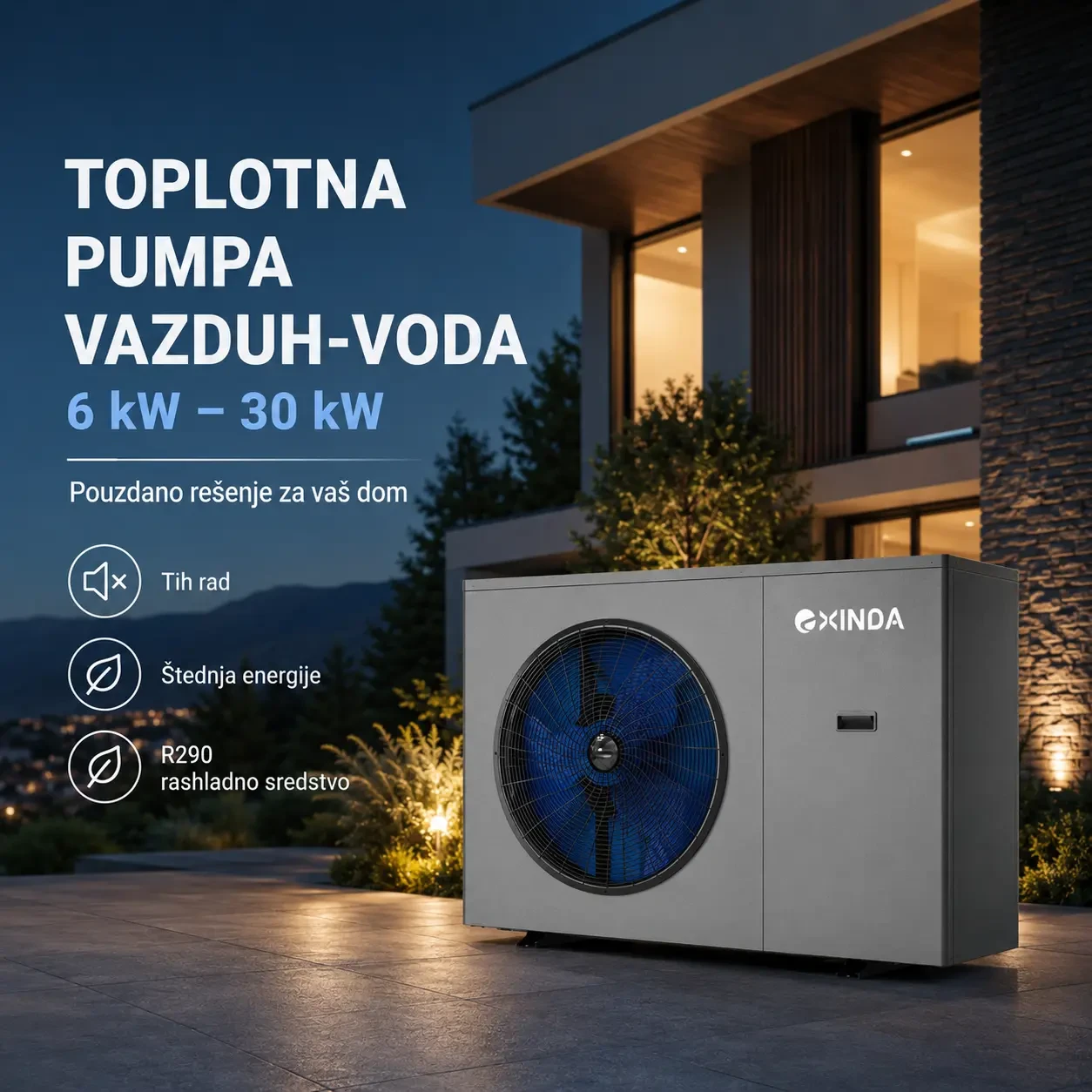
For an apartment or small house up to 80 m², the option CENTRO-GAS installs is the Exinda 6 kW R290. Its capacity is confirmed for your home in a sizing consultation before any offer. The 6 kW unit is not currently in stock; it is available to order, with price on request.
Apartment check before you ask for an offer
Five yes or no questions show whether your apartment can take a heat pump. Not every apartment can host an outdoor unit, because building rules and district heating terms vary.
| Question | If yes | If no |
|---|---|---|
| Does the apartment have its own heating circuit? | A heat pump can connect to it | Check district heating terms with your provider first |
| Is there a permitted place for the outdoor unit? | Plan the position and the distance to windows | A heat pump may not suit this apartment |
| Is there space for a hot water tank? | Plan the tank in the bathroom, utility corner or storage room | Discuss hot water options at the site visit |
| Is the electrical supply adequate? | The installer confirms meter and circuit capacity | The installer checks what needs upgrading first |
| Are there water-based radiators or underfloor heating? | Check that the emitters suit the unit's flow temperature | Plan new pipework for radiators or fan coils |
If your apartment is on district heating
Disconnection rules depend on the local district heating provider. Confirm them with the provider before any decision about a heat pump. The answer decides whether the other four questions apply at all.
Getting started
The path from first check to the best heat pump for a small house has four steps. Run the CENTRO-GAS kalkulator with your m², city and insulation, then book a sizing consultation. A site visit confirms where the outdoor unit and hot water tank can go, and the last step is a quote with installation.
CENTRO-GAS sells the unit together with sizing consultation, installation, commissioning, maintenance contracts and help checking subsidy program requirements, so one local partner handles the whole project.
Installation packages and subsidy help
CENTRO-GAS plans three installation packages, Basic, Standard and Premium, each with a service contract and priced as a complete project. State subsidies for energy-efficient heating can cover a significant share of the cost. CENTRO-GAS helps you check current program requirements and issues the pro forma invoice (predračun) you need to apply.
Pricing the complete project puts the unit, installation, accessories and commissioning in one offer. CENTRO-GAS is not yet confirmed as an approved installer in the subsidy program, so it helps check requirements and provide the pro forma invoice rather than preparing or submitting the application itself, and subsidy programs change, so the terms are confirmed at application time.
Frequently asked questions
01What size heat pump do I need for an 80 m² house?
An 80 m² house usually sits in the 6 kW band, which CENTRO-GAS uses for small homes and apartments up to roughly 80 m². The right size still depends on insulation, your town's design temperature and the heating system. A detached house in Subotica at minus 18 °C needs more than an insulated apartment in Beograd at minus 12 °C, so a sizing consultation confirms the capacity.
02Can I install an air-to-water heat pump in an apartment?
An air-to-water heat pump can work in an apartment that has its own heating circuit, a permitted place for the outdoor unit, space for a hot water tank and an adequate electrical supply. Not every apartment meets these conditions, because building rules and district heating terms vary. Check building rules and co-owner consent first, and confirm any district heating disconnection rules with your provider.
03Where can a monoblock heat pump go in a small house or apartment?
A monoblock heat pump can go on a balcony wall bracket, on a terrace floor or on a ground mount in a small yard. Because the refrigerant circuit stays inside the outdoor unit, only water pipes and wiring enter the home. A good position keeps distance from neighbouring windows, avoids hard surfaces that reflect sound and leaves a planned route for condensate water in winter.
04How loud is an air-to-water heat pump outdoor unit?
How loud an air-to-water heat pump outdoor unit sounds depends on its rated sound power and on where it sits. The datasheet lists the rated sound power for each model, so compare it before you choose a position. Noise falls with distance, and a wall-mounted unit can let sound travel more freely than one on the ground, so ask your installer for a noise assessment first.
05Does a 6 kW heat pump work on a single-phase supply?
Small heat pump units run on a standard single-phase 220-240 V supply, and the datasheet confirms the supply rating of each model: the 6 kW unit needs a minimum circuit ampacity of 16 A. Three-phase supply appears at the large end of the range, where the CENTRO-GAS 20 kW unit is a three-phase 380-415V model. The installer still checks meter and circuit capacity, especially where an electric boiler or several heaters already share the supply.
06Can a small heat pump also heat domestic hot water?
A small heat pump can heat both the home and its domestic hot water, using a hot water tank connected to the unit. EXINDA residential units work with domestic hot water tanks. In a small home, the tank usually sits in the bathroom, a utility corner or a storage room, and its size follows the number of people living in the household.
Key terminology
- Flow temperature
- Flow temperature is the temperature of the water a heat pump sends to the radiators or underfloor heating. A lower flow temperature raises efficiency, which is why large radiators and underfloor heating suit heat pumps.
- Design temperature
- Design temperature is the cold-day outdoor temperature a heating system is sized to handle in a given place. The CENTRO-GAS kalkulator uses minus 12 °C for Beograd and minus 18 °C for Subotica.
- SCOP
- SCOP is the average efficiency of a heat pump across a whole heating season. A higher SCOP means more heat for the same electricity, and the figure depends on the flow temperature behind it.
- Monoblock
- A monoblock heat pump holds the whole refrigerant circuit in one sealed outdoor unit. Only water pipes and wiring run into the home, which keeps refrigerant work outdoors.
- R290
- R290 is propane used as a refrigerant, with a low global warming potential. All EXINDA residential units use it.
- Inverter
- An inverter compressor changes its speed to match the heat the home needs. EXINDA residential units use DC inverter compressors.
Not sure 6 kW is right? Enter your m², city and insulation in the CENTRO-GAS kalkulator, then request a free sizing consultation before you buy. After the consultation, ask the CENTRO-GAS team in Novi Sad (+381 63 371 419) for a quote with installation.