+381 63 371 419


Choosing a heat pump20 min read
Best heat pump for villas and two-family houses over 230 m²
TL;DR
The short answer
The best heat pump for large house projects over 230 m² is a setup sized from heat loss at your city's design temperature, usually one 20 kW unit on three-phase power or two or more units in cascade. Because rated output falls sharply in frost, confirm the output at your city's design temperature, check the electrical supply first and plan separate circuits and hot water for each household. CENTRO-GAS designs, installs and services these systems in Serbia.
Why a house over 230 m² needs a design, not a model
When villas and two-family houses over 230 m² swap one boiler for one or more air-to-water heat pump units, a unit sized by floor area alone can fall short. Picking the best heat pump for large house projects starts with design temperature. CENTRO-GAS is the exclusive Serbian distributor of EXINDA heat pumps.
Above 230 m², the heat pump is a design decision, not a model choice. Capacity in frost, cascade, three-phase supply and zoning decide whether the house stays warm, so engineering matters more than the box. Our heat pump sizing guide covers every home size.
The three checks that matter most
A heat pump suits a villa or two-family house over 230 m² when its output at your design temperature covers the heat loss, when the load is split across units where that helps, and when the electrical supply can feed every unit. Three checks settle most of that before anyone picks a model.
1. Check capacity at your design temperature
Ask every installer for the output at your city's design temperature, not the rated output on the label. Design temperature is the outdoor temperature a heating system is sized to handle on a very cold day. Rated output falls in frost, so the datasheet figure at your design temperature is the one to compare.
2. Decide between one unit and a cascade
Ask whether the load should be split across two or more units working in cascade. A cascade can run one unit alone in mild weather and can usually keep some heat on while another unit is in service. Ask the installer to show both options for your heat loss.
3. Confirm the three-phase supply first
Confirm the supply capacity with your installer and the grid operator before you order anything. A 20 kW unit runs on 380 to 415 V three-phase power with a minimum circuit ampacity of 20 A, and every unit added to a cascade adds its own electrical load.
Criteria for the best heat pump for a large house
Score the setup, not the brand, because the right heat pump depends on the house, and Rewiring America's sizing guide calls floor-area rules of thumb almost always inaccurate. A heat loss calculation works out the heat a house needs from its insulation, windows and climate. Use the seven rows to test each proposal you receive.
| Criterion | Why it matters over 230 m² | What to ask the installer | What a good answer sounds like |
|---|---|---|---|
| Capacity at design temperature | Output falls in frost, and a large house has a large heat loss | What is the output at our city's design temperature? | A figure from a room-by-room heat loss calculation at the local design temperature |
| One unit or cascade | One large unit can run inefficiently at part load and stops all heat during service | Should the load be split across two or more units? | A side-by-side comparison of one unit and a cascade for this heat loss |
| Three-phase supply | Larger units and cascades need 380 to 415 V three-phase power | Can our supply carry every unit at full load? | A supply check with the grid operator before anything is ordered |
| Heating zones | Separate floors or households need their own circuits and controls | How many circuits are there, and who controls each one? | One circuit per floor or household, each with its own controls |
| Outdoor space and noise | A cascade needs room for several outdoor units | Where do the units go, and what base do they sit on? | A site plan with spacing, a solid base and distance from bedroom windows |
| Hot water demand | Two kitchens and several bathrooms raise hot water demand | How is the hot water tank sized and prioritised? | Tank sizing from household demand, with priority settings explained |
| Engineering and service | Load calculation, hydraulic design and commissioning decide the result | Who designs, commissions and services the system? | A local team that sizes, installs, commissions and services it |
Total heating capacity at your design temperature
Size a large house against the coldest design day of its location, not against the rated output on the label. In Serbia the design temperature ranges from minus 12 °C to minus 20 °C, so the same house needs more capacity in Subotica than in Beograd.
Design temperatures in Serbian cities
The CENTRO-GAS kalkulator uses the design temperatures in this table. Beograd at minus 12 °C and Subotica at minus 18 °C sit 6 degrees apart (18 minus 12 = 6), which changes the capacity a house needs.
| Location | Design temperature |
|---|---|
| Beograd and Niš | minus 12 °C |
| Novi Sad and Zrenjanin | minus 15 °C |
| Sombor and Užice | minus 16 °C |
| Subotica | minus 18 °C |
| Mountain areas | minus 20 °C |
Why rated output drops in frost
Rated output falls as the outdoor temperature drops, so the figure that matters is the datasheet output at your design temperature. A 2015 Building America field study of cold-climate heat pumps found a wide range of outputs and efficiencies from site to site.
Oversizing is the opposite risk. Heat Geek warns that the boiler industry left a legacy of oversized heat sources, and an oversized heat pump runs inefficiently.
Capacity bands for houses over 180 m²
In the Exinda range, 180 to 230 m² falls in the 15 kW band, while the 20 kW unit suits very large homes, light commercial and small multi-family buildings, with larger properties combining units. The right capacity still depends on insulation, climate and the heating system type, which is why CENTRO-GAS sizes every project in a consultation.
Owners of smaller homes can compare our guide for 100 to 130 m² houses.
What this means for your home: ask for the output at your own design temperature, taken from a heat loss calculation, before you compare any model.
One large unit or several units in cascade
For the largest homes, or where loads are uneven, two or more units sharing the load often fit better than one large unit. autarc places the point where a cascade often becomes more economical at a heat load of around 20 to 30 kW.
What a cascade is
A cascade connects two or more heat pumps so they share one heating load. The Energy Saving Trust's cascade guide notes that in warmer weather only one of the heat pumps needs to run to heat the property efficiently. That avoids one large unit running at part load, and if one unit stops for service, the others can usually keep some heating going.
A buffer tank is a water store between the units and the heating circuits. A 2013 DECC-commissioned study names cutting short cycling of the heat pump as the main reason to fit one.
EXINDA references at this scale
EXINDA cites a fully electric luxury villa in Italy over 700 m² running on three 20 kW R290 units. R290 is propane, a low-GWP refrigerant (low global warming potential) with high seasonal efficiency.
EXINDA also cites large cascade installations in northern China running stably at minus 25 °C to minus 40 °C since 2010. These are EXINDA references, not CENTRO-GAS installations.
Single unit versus cascade compared
The table compares the two setups point by point for a house over 230 m².
| Point | One 20 kW unit | Two or more units in cascade |
|---|---|---|
| Typical property | Very large homes (Exinda 20 kW) | Larger properties or uneven loads |
| Mild-weather efficiency | One unit runs at part load | One unit runs in its best efficiency range |
| Heat during service | Heat pump output stops | Remaining units can usually keep some heat on |
| Electrical load | One three-phase unit | Each unit adds its own load |
| Outdoor space | Room for one unit | Room for several units |
| Design effort | Simpler hydraulics | Cascade controls and a buffer tank |
What this means for your home: ask the installer to compare one unit with a cascade for your heat loss and to explain the choice in writing.
Three-phase power supply for larger units
Check the electrical supply before choosing the unit, because larger heat pumps and cascades run on three-phase power. Three-phase power is the 380 to 415 V supply these units are built for, and its capacity sets how many units a house can run. Ask for the supply figures in writing so the grid operator check uses the same numbers.
Electrical needs of 15 kW and 20 kW units
Per CENTRO-GAS product data, a 20 kW unit in the Exinda range runs on 380 to 415 V three-phase power with a minimum circuit ampacity of 20 A and breaker protection up to 25 A. The 15 kW unit runs on the same 380 to 415 V three-phase supply with a minimum circuit ampacity of 14 A and protection up to 35 A. A UK network operator, Electricity North West, advises asking an accredited installer to confirm the supply is adequate before a heat pump goes in.
Why a cascade multiplies the electrical load
Each unit in a cascade brings its own electrical draw. A three-unit cascade puts the load of three units on the supply when all of them run at full output on a design day. The supply has to carry that combined load, not the load of one unit.
Confirm supply before ordering
Ask the installer to check the connection and confirm capacity with the grid operator before ordering. After installation, the installer should notify the operator, as the ENWL heat pump guidance sets out for its own network.
What this means for your home: get written confirmation of supply capacity for every planned unit before you sign an order.
Heating zones for separate floors and households
One heat pump plant can heat several floors or two households through separate heating circuits, each with its own controls. The plant room stays shared while each floor or household sets its own comfort.
Separate circuits per floor or household
A mixing circuit guide explains that a mixing circuit blends part of the cooler return water into the supply to lower its temperature, so one heat source can feed zones at different temperatures. That lets underfloor heating and radiators run together.
Floor circuits get their own treatment in our guide to underfloor heating in new builds.
One plant, separate controls
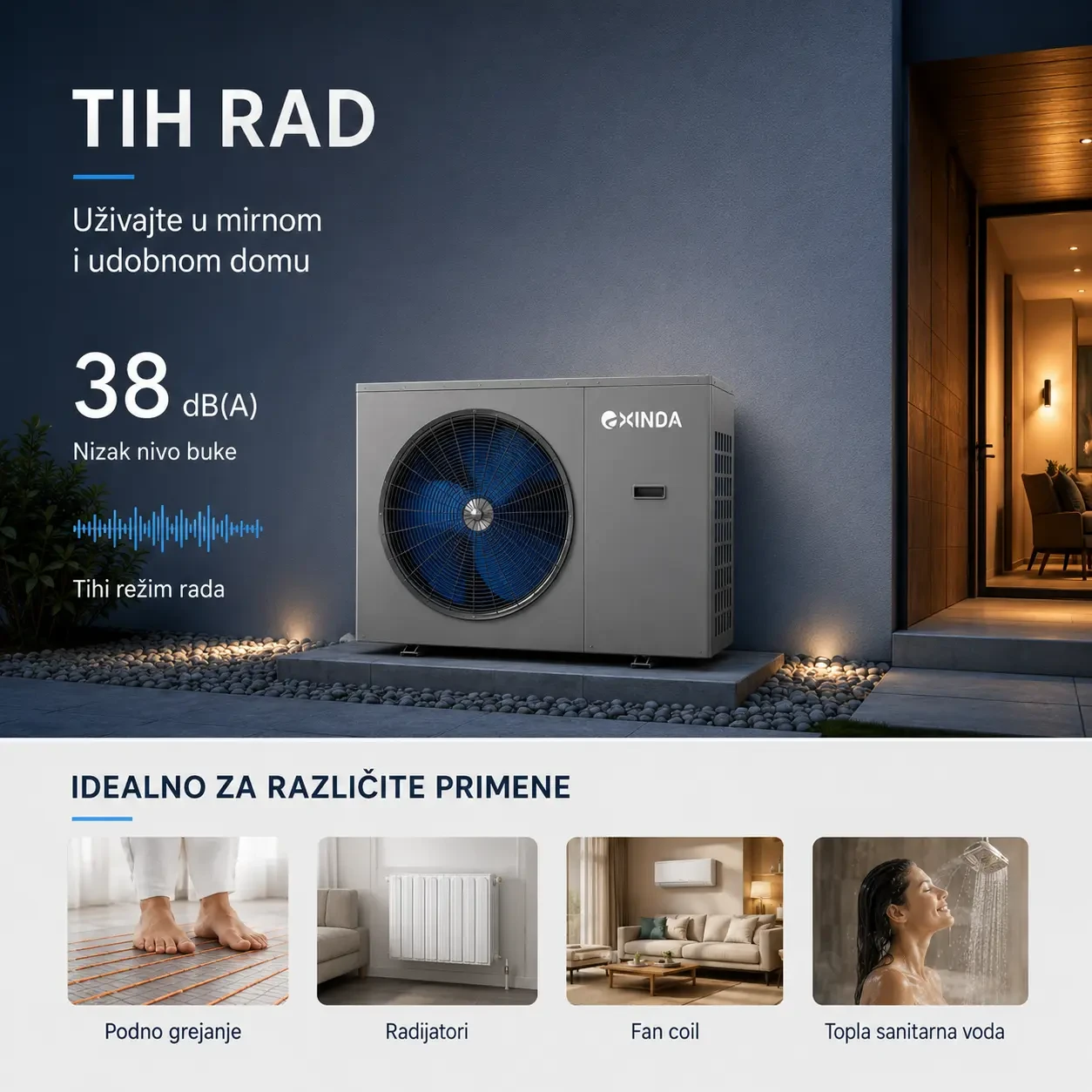
All residential Exinda units work with radiators, underfloor heating, fan coils and domestic hot water tanks. Each household can keep its own thermostat and schedule while the shared plant supplies both circuits. One buffer tank can feed both circuits from the same units.
Agree metering and cost sharing first
Two households sharing one plant should agree on heat metering or cost sharing before installation. The installer can then plan the circuits and controls around that agreement. Write it down so both households know how heating costs are split.
What this means for your home: decide how many circuits you need and who controls each one before the design is drawn.
Outdoor space, base and noise for larger units
Larger units and cascades need planned outdoor space, because each outdoor unit needs room, a solid base and distance from quiet rooms. autarc's cascade guide notes that the site must have enough space for several outdoor units.
Spacing between cascade units
Spacing between units comes from the manufacturer's datasheet and the installer's site plan. Leave access around each unit so one can be serviced while the others run.
Solid base and distance from windows and boundaries
Place each unit on a solid base, away from bedroom windows and property boundaries. Building services engineers Max Fordham advise anti-vibration mounts, especially on wall-mounted units, so vibration is not passed into the structure. They also recommend flexible pipe connections so vibration does not travel through the pipework.
Check rated sound power on the datasheet
Sound power is the noise a unit makes at its source, and Max Fordham's noise note explains that people hear it as sound pressure, which falls with distance. A university acoustics handbook notes that sound level drops by 6 dB each time the distance from the source doubles. Ask for the rated sound power of each unit from its datasheet.
What this means for your home: ask for a site plan that shows each unit, its base and its distance from bedroom windows.
Hot water demand of a large or shared household
Two kitchens and several bathrooms change how the hot water tank is sized and how hot water priority is set. A DECC-commissioned study advises sizing the cylinder on the household's likely demand.
Why more bathrooms change tank sizing
More bathrooms usually mean more people drawing hot water at once, so cylinder sizing starts from how the household uses water. The same study notes that fast recovery coils with a larger surface area shorten reheat times. The Energy Saving Trust confirms that a heat pump can heat water stored in a cylinder for taps, showers and baths.
Priority settings and a tank per household
Priority settings decide whether hot water or space heating comes first when both call for heat at once. In a two-family house, a dedicated hot water tank per household is one option, so one household's showers do not draw down the other's supply.
The DECC study records that with gas boilers, repeated hot water calls once took heat away from space heating to an unacceptable level. Priority settings exist to manage that conflict in a heat pump system.
EXINDA reference from Ireland
EXINDA cites a two-storey villa in Ireland that runs on its heat pumps for both space heating and domestic hot water. The reference is EXINDA's, not a CENTRO-GAS installation.
What this means for your home: give the installer the number of kitchens, bathrooms and occupants so the tank is sized from real demand.
Engineering depth and local service
A project this size needs load calculation, hydraulic design and commissioning more than it needs a particular box. That work is where an established industrial heating company has an advantage.
Load calculation, hydraulic design and commissioning
Flow temperature is the temperature of the water a heat pump sends to the radiators or floors. Heat Geek states: "The single biggest thing that affects system efficiency is the system design temperature." Its guidance adds that the heat loss survey alone should take 1 to 2 hours on site.
Older radiators may need higher flow temperatures or emitter upgrades. The Energy Saving Trust guidance lists radiator upgrades among the factors that affect installation cost.
Large existing houses face the same question, covered in our guide to heat pumps for older radiators.
What industrial heating experience adds
CENTRO-GAS is an established industrial burner and heat-system manufacturer and servicer with a deep technical team. It installs, commissions and services EXINDA units from Novi Sad, with consultation, maintenance contracts and after-sales support from its own team and trained local partners.
EXINDA factory backing
EXINDA's company page states that its climate chambers simulate temperatures from minus 40 °C to 60 °C and that its units operate down to minus 25 °C. EXINDA adds that its teams check completed units and use the findings to improve assembly and production. Its residential units carry a Heat Pump KEYMARK certificate (BRE Global) and a TÜV Rheinland certificate under the RED 2014/53/EU directive, with SCOP measured by TÜV Rheinland per EN 14825.
What this means for your home: choose the installer who shows the heat loss calculation and hydraulic design, not only the unit.
Pool heating, ventilation and cooling in the same design
Extras belong in one design when they share the plant room, controls or season of use, and stay separate when their loads clash with winter heating. Plan them before the main units are sized, so the capacity and outdoor space cover everything.
Pool heating with a dedicated pool heat pump
CENTRO-GAS supplies pool heat pumps with titanium heat exchangers for private, hotel and public pools. The US Department of Energy's archived pool heater guide notes that heat pump pool heaters work efficiently while the outside temperature stays above the 45 to 50 °F range, roughly 7 to 10 °C. That makes pool heating a mostly warm-season load, so a dedicated pool unit usually runs separately from the winter heating units, though it can share the plant room and controls.
Heat and energy recovery ventilation
Heat and energy recovery ventilation (HRV/ERV) brings fresh air into the house while keeping heat from the outgoing stale air. Homebuilding & Renovating calls heat recovery ventilation (MVHR) something of a must in very airtight new homes. EXINDA has HRV/ERV units in its catalog; CENTRO-GAS supplies them to order, with price and terms on request. In an airtight large house, plan ventilation and heating together because both affect the heat loss.
Summer cooling through fan coils
Fan coils are room units that blow air across coils filled with water from the heat pump. All residential Exinda units work with fan coils, and the 20 kW product page lists a cooling mode. Summer cooling through fan coils can therefore join the same design where the house needs it.
Getting started
Finding the best heat pump for large house projects follows a set order: estimate, survey, design, installation and service. Heat pumps give roughly 3 to 4 times more heat energy than the electricity they consume, which supports significantly lower heating bills when the system is sized correctly.
The unit CENTRO-GAS installs at this size
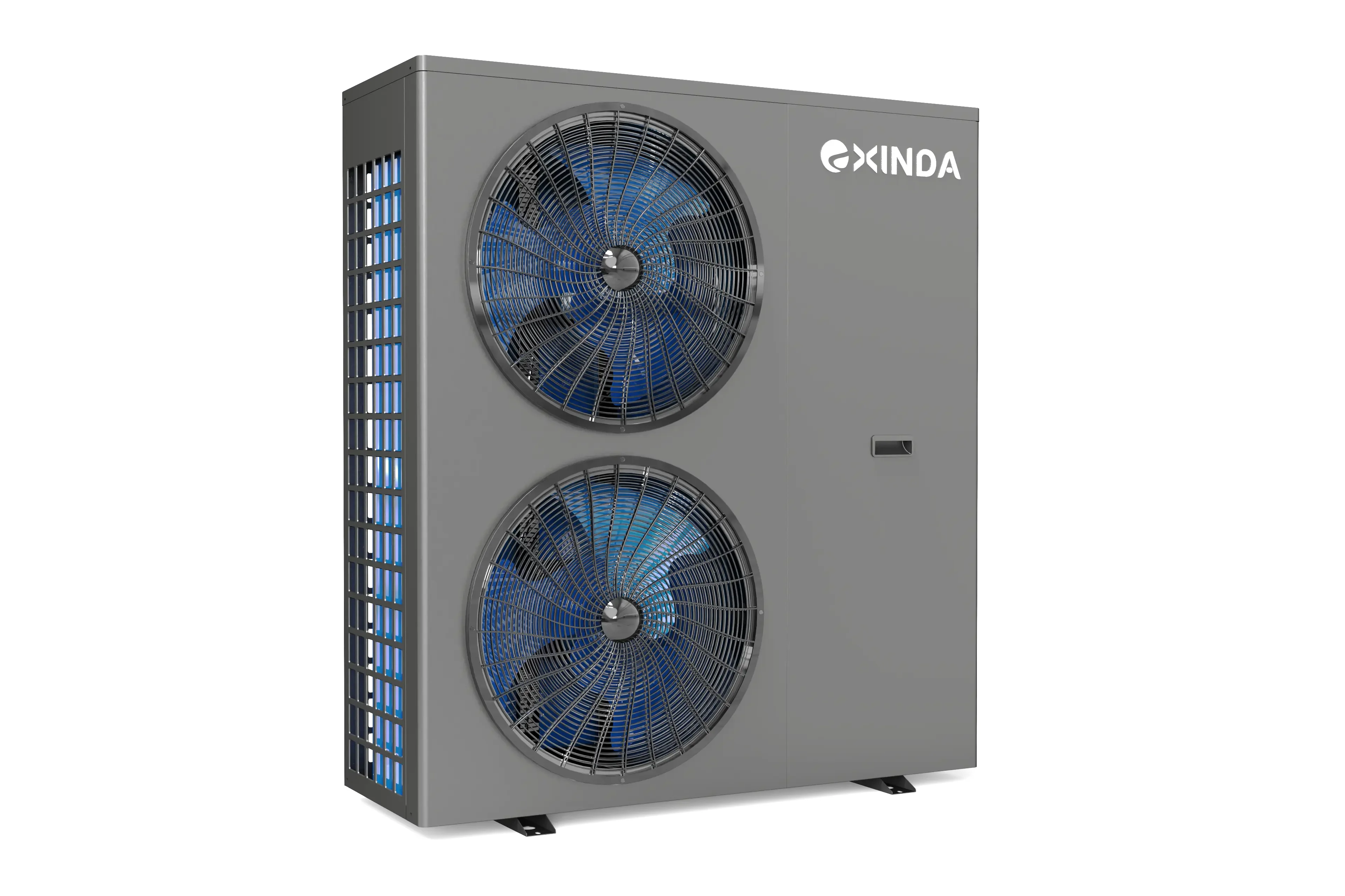
For a villa or two-family house over 230 m², the option CENTRO-GAS installs is the Exinda 20 kW three-phase 380-415V monoblock, alone or in cascade, with capacity confirmed in a sizing consultation. A monoblock keeps the whole refrigerant circuit in the outdoor unit, so only water pipes and power cables run into the house. The 12 kW and 15 kW units carry promotional pricing while the first container lasts; the 20 kW unit is not currently in stock and is available to order, price on request.
Installation packages and subsidy help
CENTRO-GAS plans three installation packages, Basic, Standard and Premium, each with a service contract and priced as a complete project. State subsidies for energy-efficient heating can cover a significant share of the cost. CENTRO-GAS helps you check current program requirements and issues the pro forma invoice (predračun) you need to apply.
How a large-house project runs
Start with an estimate from the CENTRO-GAS kalkulator, then book a heat loss survey of the house. The team then prepares the hydraulic design, installs and commissions the system, and sets up a maintenance contract. Bring floor plans and recent heating bills to the first meeting so the survey starts from real data.
Frequently asked questions
Short answers to the questions owners of large houses ask most.
01Are heat pumps suitable for large houses?
Yes, heat pumps suit large houses when they are sized from a heat loss calculation at the local design temperature. A very large house often fits two or more units in cascade, which share the load and can usually keep some heat on during service. Decent insulation and suitable emitters matter, and hybrid setups with a backup boiler remain a legitimate choice for extreme cold.
02What size heat pump for a 200 m² house?
A 200 m² house usually falls in the Exinda 15 kW band, which covers 180 to 230 m². The right size for a large house still depends on heat loss, insulation, the local design temperature and the heating system, so treat the band as a starting point. A CENTRO-GAS sizing consultation confirms the capacity before you order.
03Can two heat pumps run together in one large house?
Yes, two or more heat pumps can run together in cascade, sharing one heating load through common controls and usually a buffer tank. In mild weather one unit can carry the house alone, and if one unit is in service the other can usually keep some heating going. Each extra unit needs outdoor space and adds electrical load, so plan both early.
04Does a 20 kW heat pump need three-phase power?
Yes, the 20 kW unit in the Exinda range runs on 380 to 415 V three-phase power with a minimum circuit ampacity of 20 A, and the installer confirms the 15 kW unit's supply needs (380 to 415 V, minimum 14 A) from its datasheet. A cascade adds the load of every unit to the supply. Ask your installer to confirm supply capacity with the grid operator before ordering a heat pump for a large house.
05How does a two-family house share one heat pump system?
A two-family house can share one heat pump plant through separate heating circuits, one per household, each with its own controls. Hot water can come from a dedicated tank per household. The two households should agree on heat metering or cost sharing before installation, so the installer can design the circuits and controls around that agreement.
06Can a villa heat pump also heat a swimming pool?
A villa usually heats its pool with a dedicated pool heat pump, such as the titanium heat exchanger units CENTRO-GAS supplies, designed alongside the main system. Pool heating is a mostly warm-season load, while the main heat pump for a large house is sized for winter. Planning both together lets the installer share the plant room and controls without undersizing either one.
Key terminology
These terms appear in most heat pump quotes for large houses.
- Design temperature
- Design temperature is the outdoor temperature a heating system is sized to handle on a very cold day. In Serbia it ranges from minus 12 °C in Beograd and Niš to minus 20 °C in mountain areas.
- Flow temperature
- Flow temperature is the temperature of the water a heat pump sends to radiators or underfloor heating. Lower flow temperatures usually mean higher efficiency, which is why emitter size matters.
- Cascade
- A cascade is two or more heat pumps connected to share one heating load. It runs fewer units in mild weather and can usually keep some heat on if one unit stops.
- Monoblock
- A monoblock heat pump keeps the whole refrigerant circuit inside the outdoor unit. Only water pipes and the power supply run between the outdoor unit and the house.
- R290
- R290 is propane used as a refrigerant. It is a low-GWP refrigerant with high seasonal efficiency, and GWP (global warming potential) measures a gas's climate impact.
- Inverter
- An inverter heat pump varies its compressor speed to match the heat the house needs at that moment. All residential Exinda units use DC inverter compressors.
- SCOP
- SCOP (seasonal coefficient of performance) is the heat a system gives over a whole heating season divided by the electricity it uses. A higher SCOP means lower running costs for the same heat.
Book a free CENTRO-GAS engineering consultation to size a single unit or cascade from your heat loss and hot water demand, then request a quote with installation. Call +381 63 371 419 to arrange it.