+381 63 371 419


Choosing a heat pump18 min read
Best heat pump for old houses with radiators: 7 criteria

TL;DR
The short answer
The best air to water heat pump for radiators in an old house is one sized for your city's winter design temperature that still heats the existing radiators at 45 to 55 °C water (flow) temperature. For a 140 to 180 m² old house that usually means a 15 kW unit, since a 12 kW unit gives only about 6 kW at minus 15 °C against an estimated 11 to 22 kW heat loss for that size. CENTRO-GAS, the exclusive Serbian distributor of EXINDA air-to-water heat pumps, checks radiators, insulation and electrical supply before recommending a unit. If radiators fall short, larger radiators, insulation or a hybrid closes the gap.
Older brick houses, radiators and heat pumps
Older Serbian brick houses often have solid masonry walls, little insulation and cast iron or steel panel radiators sized for 70 to 80 °C boiler water. Owners replacing a gas, oil or solid fuel boiler can check what makes the best air to water heat pump for radiators before any quote.
Here the best heat pump is sized for the local design temperature and matched to the flow temperature the radiators need. CENTRO-GAS therefore assesses radiators at 45 to 55 °C before recommending a unit, upgrades or a hybrid. The heat pump sizing guide covers the full kW range.
The three checks that matter most
A heat pump suits an older brick house with radiators when its cold-day output covers the heat loss and the radiators warm each room at low water temperatures.
- Size on output at your city's design temperature, since a unit rated 12 kW delivers about 6 kW at minus 15 °C.
- Confirm the radiators heat each room at 45 to 55 °C flow.
- Check for three-phase supply before choosing a unit above 12 kW.
Heat pumps heat radiators to a lower temperature than boilers do, as the SEAI homeowner's guide explains, so the radiator check decides comfort.
| Criterion | Why it matters in an old house with radiators | What to ask the installer | What a good answer sounds like |
|---|---|---|---|
| 1. Capacity at your local winter design temperature | Brick walls with little insulation lose more heat per m², and output falls in cold weather | What is the heat loss at our design temperature, and what does this unit give at that temperature? | A heat loss figure for your house, compared with the unit's output at your city's design temperature |
| 2. Maximum flow temperature your radiators need | Radiators sized for 70 to 80 °C boiler water give less heat at 45 to 55 °C | Will each room reach its target temperature at 45 to 55 °C flow? | A room-by-room check that names any radiator needing an upgrade |
| 3. Seasonal efficiency at higher flow temperatures | Efficiency falls as flow temperature rises | Which flow temperature is this design based on? | The lowest flow temperature that still heats every room |
| 4. Single-phase or three-phase electrical supply | The 15 kW needs 380 to 415 V and the 20 kW is three-phase 380 to 415V | Does the supply in my house match this unit? | A check of your connection against the unit's supply needs before the order |
| 5. Outdoor noise and placement in a yard | The monoblock outdoor unit holds the whole refrigerant circuit and stands in the yard | Where will the unit stand, and what is its rated sound power? | A spot away from bedroom windows and the boundary, on a solid base with anti-vibration mounts |
| 6. Domestic hot water and space for a tank | Hot water needs higher temperatures than space heating, and a combi boiler has no tank | Where will the hot water tank go? | A named place for the tank and a list of the hydraulic parts |
| 7. Local installation and service | Radiator checks and hybrid wiring need judgment on site | Who commissions and services the system? | The same local team sizes, installs, commissions and services it |
1. Capacity at your local winter design temperature
An uninsulated brick house loses more heat per m² than a modern one, so the m² bands on the shop are only a starting point. The design temperature is the outdoor temperature a heating system is sized to handle in your area, and the heat pump must cover the house's heat loss at that temperature.
Bigger is not automatically safer. Heat Geek warns: "The boiler industry has left a huge legacy of over-sized heat sources."
Design temperatures across Serbia
The CENTRO-GAS kalkulator uses these design temperatures.
| City or area | Design temperature |
|---|---|
| Beograd and Niš | minus 12 °C |
| Novi Sad and Zrenjanin | minus 15 °C |
| Sombor and Užice | minus 16 °C |
| Subotica | minus 18 °C |
| Mountain areas | minus 20 °C |
Source: the CENTRO-GAS kalkulator. Under the kalkulator rule, a unit rated 12 kW delivers about 6 kW at minus 15 °C, which is half its nameplate output (6 kW out of 12 kW).
How the kalkulator estimates a 150 m² older house
For a 150 m² older house, the kalkulator compares two figures: the heat loss at the design temperature (minus 15 °C in Novi Sad, minus 18 °C in Subotica) and the unit's derated output at that temperature. A house of this size typically loses an estimated 80 to 120 W/m², which is roughly 11 to 22 kW at the design temperature for a 140 to 180 m² house, well above what a 12 kW unit gives at minus 15 °C. Any result is a calculator estimate, not a measured result, and a sizing consultation confirms it.
Smaller homes follow the same logic, covered in the guide for a 100 to 130 m² house.
What this means for your home: Ask for the heat loss at your city's design temperature and compare it with the unit's output there, not its nameplate kW.
2. Maximum flow temperature your radiators need
Flow temperature is the temperature of the water the heat pump sends to the radiators. Exinda residential units supply flow temperatures up to 60 °C. Higher flow costs efficiency, so the real test for a heat pump with existing radiators is how low the water temperature can go while every room stays warm.
Why boiler-sized radiators give less heat at 45 to 55 °C
Radiators in older houses were sized for 70 to 80 °C boiler water, and at 45 to 55 °C they give out less heat. The SEAI flow temperature guidance states: "If the temperature of the water flowing through a radiator is reduced, then the heat output of the radiator is also reduced."
Underfloor heating works at lower water temperatures than radiators, the case covered in the guide to new build underfloor heating.
A self-check you can do this winter
Are the rooms still warm today with the boiler set to a lower temperature? Note which rooms are hardest to heat, because those radiators decide the design. The Energy Saving Trust lists radiator sizing among the factors that affect heat pump running costs.
What this means for your home: If the rooms stay warm with the boiler set lower, your radiators are a good sign for a heat pump. If one or two rooms struggle, those radiators are the first upgrade to price.
3. Seasonal efficiency at higher flow temperatures
SCOP (seasonal coefficient of performance) is a heat pump's average efficiency across a whole heating season. Efficiency falls as flow temperature rises, so a house that needs hotter radiators gets less heat from each unit of electricity.
In a worked example from OpenEnergyMonitor, raising flow from 35 °C to 45 °C cut COP (efficiency at one operating point) from 4.2 to 3.4. These are example figures, not Exinda data.
What 3 to 4 times more heat means in an old house
Heat pumps give out roughly 3 to 4 times more heat energy than the electricity they consume. An old house on 55 °C flow sits at the lower end of what a heat pump can achieve, so the efficiency case rests on keeping flow as low as the radiators allow. The Energy Saving Trust rates heat pumps as more than three times more efficient than a gas or oil boiler.
Every degree saved lowers running costs
A radiator upgrade that lets the system run a few degrees cooler lowers running costs for the life of the heat pump. Combined with the 3 to 4 times efficiency, that is how a heat pump in an old house can bring significantly lower heating bills.
What this means for your home: Ask which flow temperature the quote assumes. A lower figure, reached with a few radiator changes if needed, means lower running costs every winter.
4. Single-phase or three-phase electrical supply
Exinda residential units run on a 220-240V single-phase supply up to 12 kW. The minimum circuit ampacity is 16 A for the 6 kW unit, 21 A for the 9 kW unit and 28 A for the 12 kW unit, each with matching breaker protection. Each unit uses an inverter compressor, which varies its speed to match the heat the house needs.
When you need three-phase power
Above 12 kW the supply changes. The 15 kW needs 380 to 415 V with a 14 A minimum circuit, and the 20 kW is a three-phase 380-415V unit needing at least 20 A. The 20 kW monoblock is meant for very large homes, light commercial use and small multi-family buildings.
Larger homes reach these sizes, and the guide for a villa or two-family house covers them.
Check your house before choosing above 12 kW
Older houses often do not have three-phase power, so check the connection before choosing a unit above 12 kW. The SEAI homeowner's guide lists electrical connection needs, such as a 3-phase connection, among the questions to ask an installer.
What this means for your home: Check the electricity connection before you settle on 15 kW or 20 kW. A single-phase house limits the choice to units up to 12 kW unless the supply changes.
5. Outdoor noise and placement in a yard
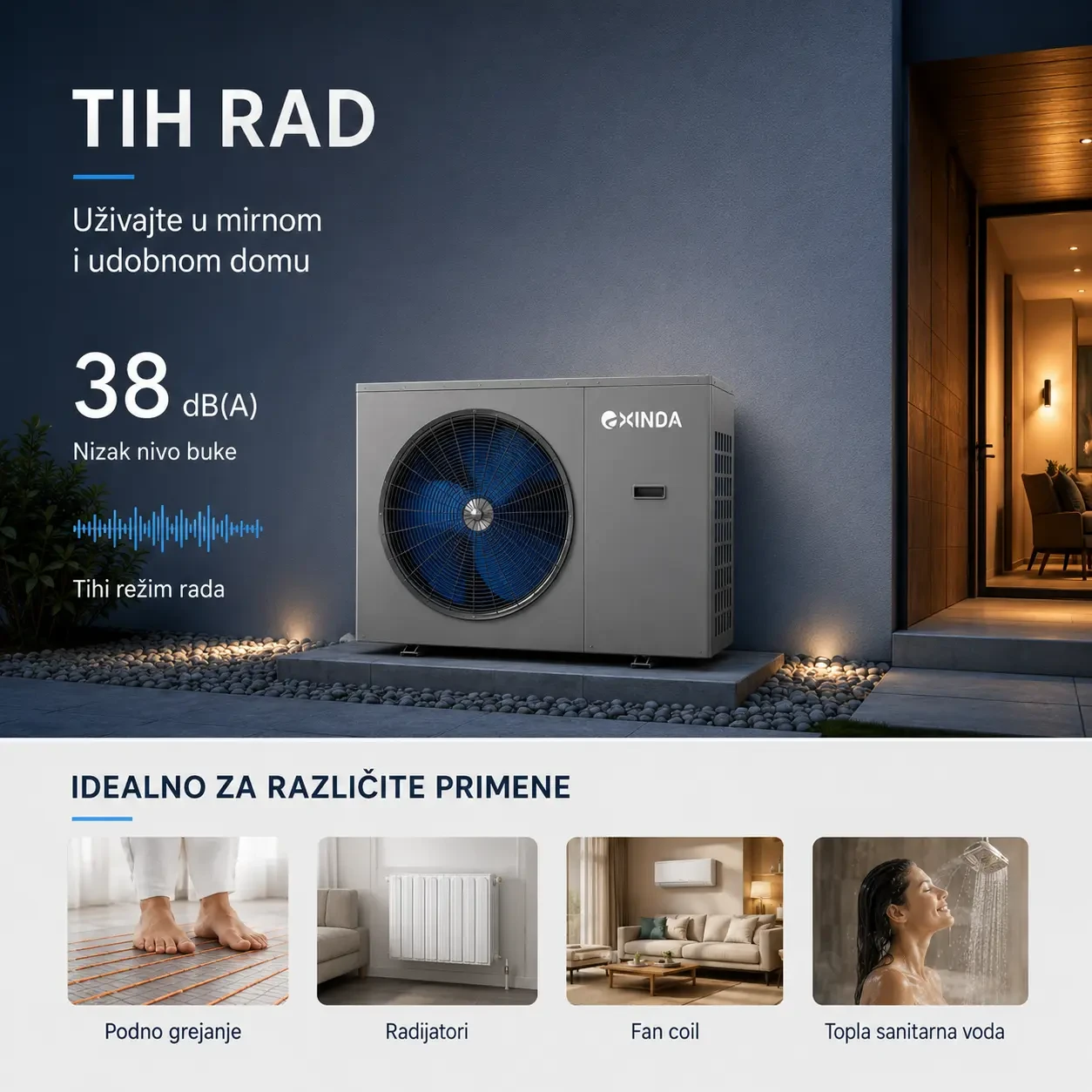
Exinda residential units are monoblock units, which means the whole refrigerant circuit sits in the outdoor unit. That unit stands in the yard, often close to a neighbour, so its position matters as much as its size.
Distance from windows and the neighbour's boundary
BRANZ, New Zealand's building research body, advises against placing an outdoor unit close to or beneath a bedroom window and recommends a concrete pad or slabs on a solid compacted base. On vibration, it states: "Outdoor units should be installed on isolation mounts or pads."
A City of North Vancouver guide adds two rules for neighbours: keep the unit away from their windows, and place it as far from the property line as possible.
Reading the datasheet sound figure
Most manufacturers state a lab-tested sound power rating in dB(A), according to the North Vancouver installation guide. Ask the installer for the datasheet figure of the exact model in your quote.
What this means for your home: Agree the unit's position before installation, away from bedroom windows and the boundary, on a solid base with anti-vibration mounts. Check its rated sound power on the datasheet.
6. Domestic hot water and space for a tank
The same heat pump that heats the radiators can also heat a hot water tank. Hot water needs higher temperatures than space heating, so the tank belongs in the design from the start. The IEA heat pump programme notes that raising stored hot water to the 60 °C recommended for Legionella control lowers energy efficiency.
Replacing a combi boiler
An older house that replaces a combi boiler with a heat pump needs room for a hot water tank. Plan where the tank goes at the survey stage. Heat Geek's Legionella guide notes that heat pump controllers often include a built-in sterilisation cycle and that a cooler cylinder loses less energy.
Hydraulic parts the installer will plan
The installer plans the hydraulic side of the system, which can include a buffer tank, a pump group and an expansion vessel. Which parts a given house needs is decided at the survey, not taken from a standard list.
What this means for your home: If you have a combi boiler today, find space for a hot water tank before the survey. Expect the quote to list the hydraulic parts your system needs.
7. Local installation and service
CENTRO-GAS is an established Novi Sad industrial heating company that installs, commissions and services what it sells. In an old house, that matters most where radiator checks and hybrid wiring need judgment on site. CENTRO-GAS sizes, installs, commissions and maintains the systems it supplies, and helps customers check subsidy program requirements.
What EXINDA testing covers
EXINDA's published company facts list a 60,000 m² campus with 5 laboratories and climate chambers that simulate temperatures from minus 40 °C to 60 °C, with units operating down to minus 25 °C. EXINDA's teams check completed units in production, and its R290 models carry a Heat Pump KEYMARK certificate (BRE Global) and a TÜV Rheinland certificate under the RED 2014/53/EU directive, with SCOP measured by TÜV Rheinland per EN 14825. The 9, 12 and 15 kW units also hold an EU declaration of conformity (CE) and a Serbian conformity certificate from Kvalitet a.d. Niš with the AAA mark.
All residential Exinda units use R290, which is propane used as a refrigerant with a low global warming potential (GWP, a measure of climate impact). Heat exchanger maker Alfa Laval puts the GWP of propane at just 3.
Questions to ask any installer
Three questions sort installers quickly. Who calculates the heat loss at your design temperature, who checks each radiator at 45 to 55 °C flow, and who commissions and services the system afterwards?
What this means for your home: Choose an installer who will check the radiators, size the unit and come back to service it. In an old house, those steps decide the result.
Heat pump only, upgrades first or a hybrid: picking a path for an old house
Not every old house will match boiler comfort on a heat pump alone. There are three honest paths: a heat pump only, a heat pump with targeted upgrades, or a hybrid that keeps the existing boiler for the coldest days. Each suits a different house and needs a different check from the installer.
Heat pump only
This path suits houses whose radiators already heat each room at 50 to 55 °C flow. The installer must check room-by-room heat output at that flow before quoting.
On the water side, Heat Geek names the main factor: "The single biggest thing that affects system efficiency is the system design temperature." Here that means the design flow temperature, the water temperature the radiators need on a cold day, not the outdoor design temperature.
Heat pump plus targeted upgrades
This path suits houses where one or two rooms struggle at heat pump temperatures. A few larger radiators, attic insulation and sealed windows can lower the flow temperature the house needs. The installer must find the hardest rooms to heat and price the upgrades against a larger unit.
Trystan Lea explains that lower water temperatures call for larger radiators, more radiators or longer run times, and that upgrading radiators is often a good idea.
Hybrid with the existing boiler
This path suits houses with high heat loss or radiators that are hard to upgrade. The heat pump covers most of the season, and the existing boiler covers the coldest days. A UK government evidence report describes the boiler topping up space heating when a hybrid works with existing high temperature radiators.
CENTRO-GAS can price a hybrid option alongside a full heat pump installation in one quote.
Getting started
Start with your city's design temperature, then check the radiators at 45 to 55 °C, then confirm the electrical supply. With those three answers, ask for a quote on the best air to water heat pump for radiators in your house, covering installation, commissioning and service, not a unit price alone.
Radiator outputs are rated under the EN 442 test (75 °C flow, 65 °C return, 20 °C room), a ΔT of 50 °C between average water and room temperature, as OpenEnergyMonitor's heat pump basics explains. Ask the installer to convert each radiator's rating to heat pump temperatures.
The typical option for a 140 to 180 m² older house
For a 140 to 180 m² older brick house with radiators, EXINDA technical data shows a 12 kW unit gives only about 5.6 to 6.2 kW at minus 15 °C, while a house this size typically loses an estimated 11 to 22 kW at that temperature. CENTRO-GAS therefore typically recommends the Exinda 15 kW unit, which gives about 8.1 to 9.0 kW at minus 15 °C, paired with a hybrid boiler backup or a cascade of units where the heat-loss calculation shows a larger gap. A 12 kW unit on its own suits a smaller older house, up to about 100 m², and only if it is partly insulated; otherwise it needs a backup boiler or heater. Capacity is always confirmed in a sizing consultation, and correct capacity depends on insulation, climate and the type of heating system.
Installation packages
CENTRO-GAS plans three installation packages: Basic, Standard and Premium. Each comes with a service contract and is priced as a complete installation, not as a unit alone. The 12 kW and 15 kW units carry promotional pricing while the first container is in stock; the 9 kW unit is in stock at the standard shop price, and the 6 kW and 20 kW units are available to order, price on request.
Help with subsidy paperwork
State subsidies for energy-efficient heating can cover a significant share of the cost. CENTRO-GAS helps you check current program requirements and issues the pro forma invoice (predračun) you need to apply.
Frequently asked questions
01Can a heat pump work with old radiators?
Yes, a heat pump can work with old radiators when they heat each room at 45 to 55 °C flow. Radiators sized for 70 to 80 °C boiler water give out less heat at those temperatures, so some rooms may need a larger radiator. Exinda residential units reach up to 60 °C, but lower flow keeps running costs down, and a room-by-room check settles the question.
02What flow temperature do radiators need with a heat pump?
CENTRO-GAS assesses radiators at 45 to 55 °C flow, and the lower the figure, the better the seasonal efficiency. The right figure for your house is the lowest flow at which every room still reaches its target temperature on a cold day. Exinda residential units can supply up to 60 °C, though running that hot lowers efficiency and raises running costs.
03Do I need to insulate an old house before installing a heat pump?
Not always, but insulation often makes a smaller unit and a lower flow temperature possible. Attic insulation and sealed windows cut heat loss, which lowers the capacity the house needs at its design temperature. A sizing consultation shows whether insulation, a few larger radiators, more capacity or a hybrid setup suits your house and budget.
04Should I keep my gas boiler as a backup with a heat pump?
Keeping the gas boiler as a backup makes sense when the house has high heat loss or radiators that struggle at heat pump temperatures. In that hybrid setup, the boiler only steps in on the coldest days while the heat pump carries the rest of the winter. CENTRO-GAS can quote the hybrid and a full heat pump installation side by side.
05What size heat pump does an old brick house need?
An old brick house needs a heat pump sized on its heat loss at the local design temperature, not on floor area alone. For a 140 to 180 m² house, that typically means 15 kW, since a unit rated 12 kW delivers only about 6 kW at minus 15 °C, the design temperature for Novi Sad and Zrenjanin, against a heat loss that usually runs well above that. A sizing consultation confirms the right capacity for your house.
06Is a heat pump worth it in a poorly insulated house?
A heat pump can be worth it in a poorly insulated house when it is sized for the design temperature and the radiators work at 50 to 55 °C, or when upgrades or a hybrid close the gap. Heat pumps give out roughly 3 to 4 times more heat energy than the electricity they consume, though a house on 55 °C flow sits at the lower end.
Key terminology
- Flow temperature
- Flow temperature is the temperature of the water leaving the heat source for the radiators. Boilers run radiators hotter than heat pumps, which work most efficiently at lower flow.
- Design temperature
- Design temperature is the outdoor temperature a heating system is sized for in a given area. The CENTRO-GAS kalkulator uses minus 12 °C for Beograd and Niš and minus 18 °C for Subotica.
- SCOP
- SCOP, or seasonal coefficient of performance, describes a heat pump's average efficiency over a full heating season. It falls as the flow temperature the house needs rises.
- Monoblock
- A monoblock heat pump keeps its whole refrigerant circuit inside the outdoor unit. All residential Exinda units use monoblock design.
- R290
- R290 is propane used as a refrigerant. It has a low global warming potential, and all residential Exinda units use it.
- Inverter
- An inverter compressor changes its speed to match the heat the house needs. All residential Exinda units use DC inverter compressors.
Check your radiators before you buy: run the CENTRO-GAS kalkulator for your city's design temperature, then book a free sizing consultation that includes a radiator assessment at 45 to 55 °C flow temperature and a quote with installation. Call +381 63 371 419 or write to centro-gas@centro-gas.com to book.